



Specs & Systems
Choose your preferred CNC systems, motor power, and automation levels for maximum efficiency.


Open Hours:8:30am-20:30pm

WhatsApp: +86 198-5901-3937
@2x.webp)
@2x.webp)
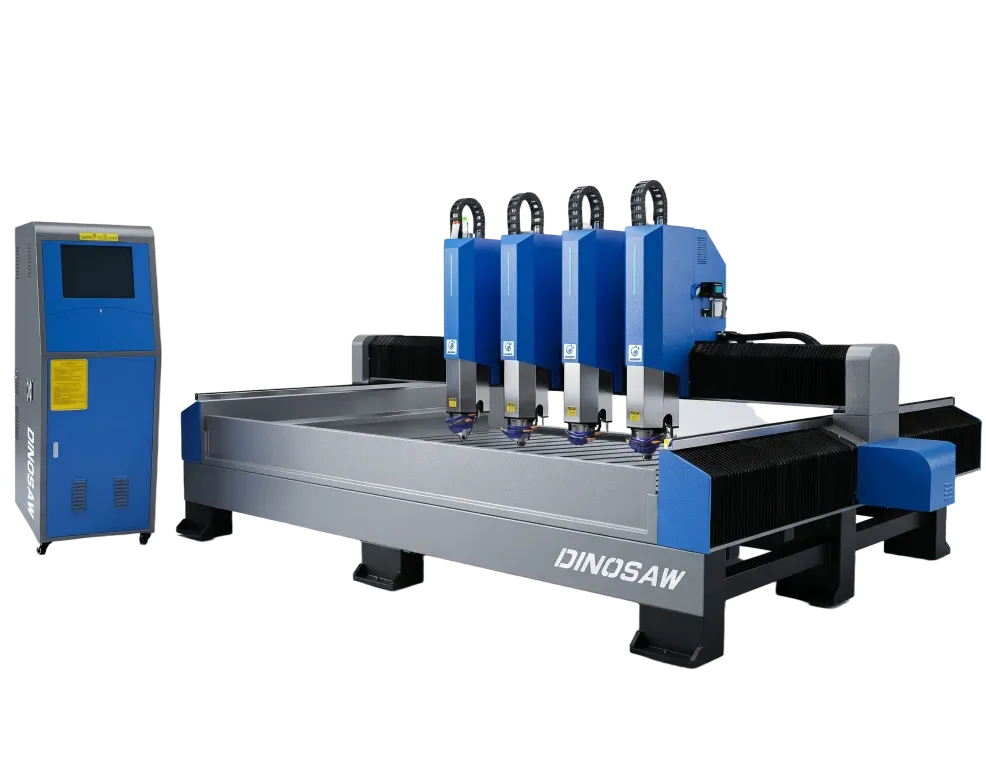
The ZDDK series operates in three distinct working modes, each unlocking a different class of output. Understanding which mode suits your primary production type is the fastest path to the right configuration.
Three working modes
Working mode | Setup | Max workpiece height | Typical applications |
Standard flat-bed mode | Full worktable in place | Up to 300 mm | Relief panels, flat tombstones, headstones, tile engraving, architectural cladding, 2D/3D surface relief on slabs |
Rotary mode (with tailstock supports) | Rotary axis fixture + tailstock supports mounted on both sides of the worktable | Diameter to suit rotary fixture | Cylindrical carving: columns, vases, balusters, railings, decorative pillars — any workpiece with rotational symmetry |
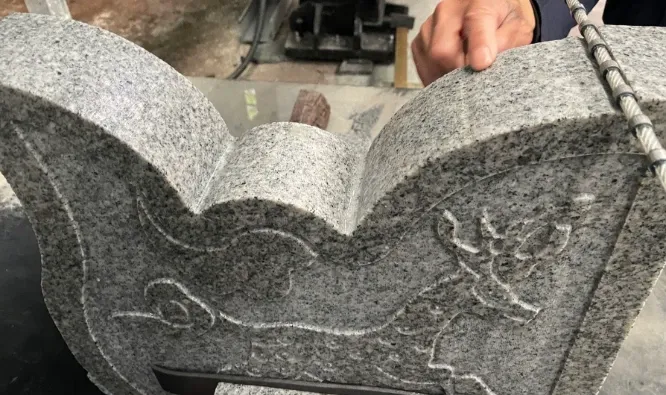
Deep-carving open-bed mode | Worktable removed; open floor clearance | Up to 600 mm | Freestanding sculptures, small-to-medium statues, artistic stone pieces, architectural elements exceeding standard slab thickness |
Base specifications
Parameter | ZDDK-1325 | ZDDK-3015 |
|---|---|---|
Working area (X × Y) | 1,300 × 2,500 mm | 3,000 × 1,500 mm |
Positioning accuracy | ±0.03 mm (repeatable) | ±0.03 mm (repeatable) |
Spindle runout | < 0.005 mm | < 0.005 mm |
Frame construction | Stress-relieved heavy-duty steel, high-temperature annealed + naturally aged | Stress-relieved heavy-duty steel, high-temperature annealed + naturally aged |
Sealing (rails & ball screws) | 360° nano-grade flexible bellows + automated lubrication | 360° nano-grade flexible bellows + automated lubrication |
Control system | Industrial CNC controller with look-ahead algorithm | Industrial CNC controller with look-ahead algorithm |
CAD/CAM compatibility | AutoCAD (DXF), ArtCAM, Type3, SprutCAM | AutoCAD (DXF), ArtCAM, Type3, SprutCAM |
Compatible materials | Granite, marble, limestone, sandstone, travertine, onyx, jade, artificial stone, ceramic, glass | Granite, marble, limestone, sandstone, travertine, onyx, jade, artificial stone, ceramic, glass |
Cooling | Water-cooled spindle | Water-cooled spindle |
Dust/water protection | Full-sealed rails and drive components | Full-sealed rails and drive components |
Optional configurations
The ZDDK series is designed for configuration at the point of order, not retrofitting. Specify your primary production mix and Dinosaw will recommend the right option set.
Option | What it adds | Best for |
|---|---|---|
Multi-spindle heads (2, 4, or more heads) | Multiple identical pieces carved simultaneously on the same worktable — same program, multiplied output | Monument shops and factories processing large batches of same-size pieces: matching headstone sets, identical decorative tiles, repeating baluster profiles |
Rotary axis + tailstock support fixture | Enables rotary mode for cylindrical workpieces without worktable removal | Shops combining flat relief work with column and vase production |
Upgraded spindle power | Higher-torque spindle for harder materials (granite, quartzite) or faster material removal rates on deep carving | High-volume granite producers; deep-carving mode users |
High-precision linear guide upgrade | Enhanced rail specification for tighter tolerance on fine detail work | Artistic relief work requiring sub-0.02 mm surface accuracy; portrait engraving |
3D scanning module | Digitises an existing physical object into a 3D model file; outputs toolpath for direct CNC replication | Shops replicating existing sculptures or client-supplied originals at production scale; batch reproduction from a single master model |
The ZDDK series covers a wide range of stone engraving and carving work — but the right configuration depends entirely on the mix of work you run. Three questions determine the specification.
This single question determines which working modes matter to you and whether the base machine is sufficient or needs the rotary and open-bed capability.
Batch size and piece variety are the two variables that most directly affect the value of multi-spindle and 3D scanning options.
The standard spindle configuration handles granite, marble, and most natural stone types effectively. Two situations warrant the upgraded spindle:
The ZDDK series provides native compatibility with AutoCAD (DXF), ArtCAM, and Type3 — the three most common stone engraving design platforms. If your team works primarily in ArtCAM or Type3, no conversion step is required between design and machine. If you use other CAD platforms, confirm file export capability before finalising the order.
For shops with no existing CAD workflow and no dedicated programmer, the 3D scanning module with SprutCAM integration provides a practical path: scan the physical piece, generate the toolpath, run the program. One general operator can manage setup and start the run without specialist CNC programming knowledge.
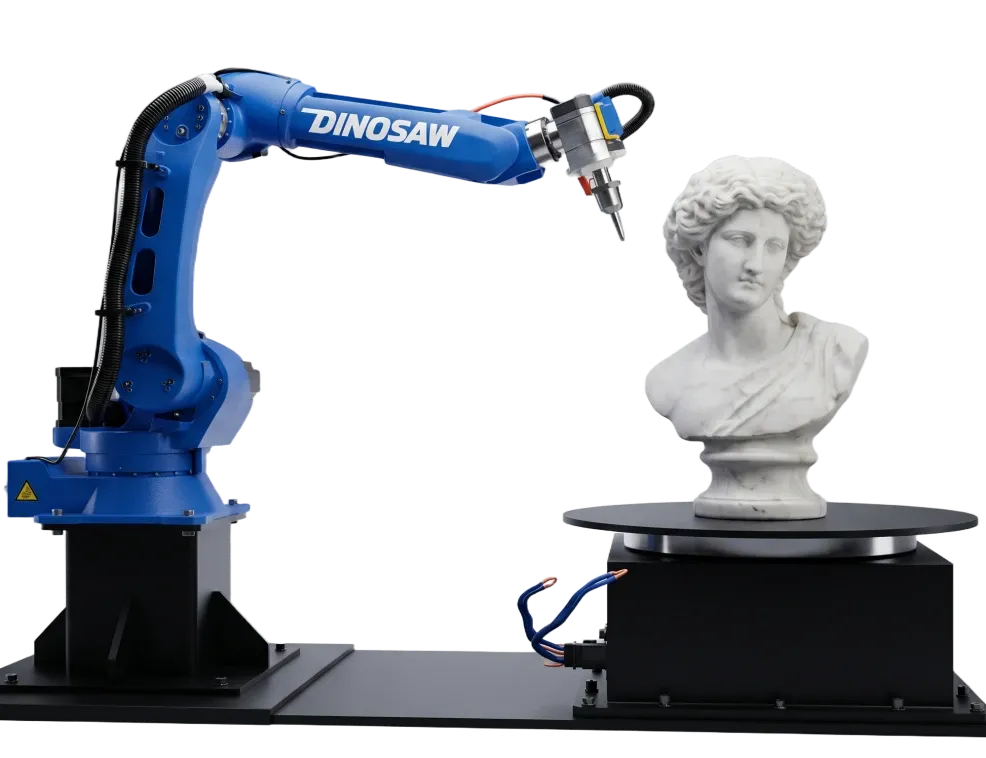
The DS-KR210 is built on a KUKA industrial robot base — one of the few stone carving systems in the market integrating a name-brand industrial robot arm rather than purpose-built stone machinery. This matters because KUKA arms are rated for 70,000 MTBF hours and a 15-year service life, and they carry the mechanical precision and certification history of industrial automation rather than stone-specific equipment. The stone carving capability is Dinosaw's engineering layer on top of that foundation.
Core specifications
Parameter | DS-KR210 R2700 |
|---|---|
Robot base | KUKA industrial robot arm |
Axes | 7-axis |
Working reach (circumference) | 3,100 mm working perimeter |
MTBF (rated service life) | 70,000 hours / approx. 15 years |
Positioning accuracy | High-precision — axes integrated directly in the arm |
Tooling compatibility | Saw blades, mill cutters, engraving bits (interchangeable) |
Programming software | SprutCAM (offline programming system for complex 3D workpieces) |
Workpiece capability | Full 3D geometry: statues, sculptures, columns, architectural elements, large-format reliefs |
Compatible materials | Granite, marble, limestone, sandstone, travertine — all natural stone types used in monumental and architectural work |
Operating environment | Designed for harsh industrial environments (dust, water, vibration) |
These two machines overlap in some applications and are completely distinct in others. Choosing between them — or running both — comes down to workpiece geometry, batch structure, and whether you have technical staff to manage programmable automation. This guide covers both machines together because the most important question buyers ask is which one they need.
The robotic system requires reprogramming for each new workpiece geometry. For a workshop producing varied custom pieces — different designs each week, client-specific one-offs, repair and restoration work — the programming overhead negates the machine's efficiency advantage over a CNC router. If your primary challenge is throughput on flat relief or moderate 3D work, the CNC engraving machine will deliver better cost-per-piece economics. The robotic system earns its return on investment through production volume of complex three-dimensional pieces, not through variety.
Stone engraving operations vary as much as the pieces they produce. A monument company running identical granite headstones at volume has different engineering requirements from an architectural studio finishing one-off marble relief panels, or a sculpture workshop reproducing Buddhist figures from a master scan. Standard machine configurations are a starting point, not a ceiling.
Dinosaw works with stone engraving operations to configure machines around the specific demands of their production: worktable dimensions sized to your standard slab format rather than a generic footprint; multi-spindle configurations matched to your piece count and batch size rather than an off-the-shelf head count; spindle power and guide specifications selected for your primary stone hardness rather than a general-purpose compromise; integration of 3D scanning into the workflow when reproduction from physical originals is a regular requirement. For operations considering the robotic carving system, Dinosaw's engineering team supports SprutCAM programming setup and operator training as part of the commissioning process, and can advise on the tooling configuration — saw blades, mill cutters, engraving bits — that best matches the geometry of your target workpieces. Describe your production profile and the pieces you are building toward, and Dinosaw will specify the configuration that makes the economics work.
Choose your preferred CNC systems, motor power, and automation levels for maximum efficiency.
Adjust table dimensions, rail lengths, and cutting thickness to fit your workshop and slab sizes.
Private label services including custom machine colors and logo placement on hardware and software UI.
 English
Get A Easy Solution
Chat Online
Hi, this is Lizzy from Dinosaw ( Not a Robot ). Which Machine ( model ) do you want? Please WhatsApp us now
Hello 👋 How can we help?
 中文
中文 Italian
 Türkçe
 Português
 Español
 Deutsch
 العربية
 Tiếng Việt
 Français
 Русский
 한국어
한국어