



 中文
中文 Italian
 Türkçe
 Português
 Español
 Deutsch
 العربية
 Tiếng Việt
 Français
 Русский
 한국어
한국어


Ms.Lizzy
Hi, this is Lizzy from Dinosaw ( Not a Robot ). Which Machine ( model ) do you want? Please WhatsApp us now


Open Hours:8:30am-20:30pm

WhatsApp: +86 198-5901-3937

 Sep 16, 20255 MIN READ
 Sep 16, 20255 MIN READ
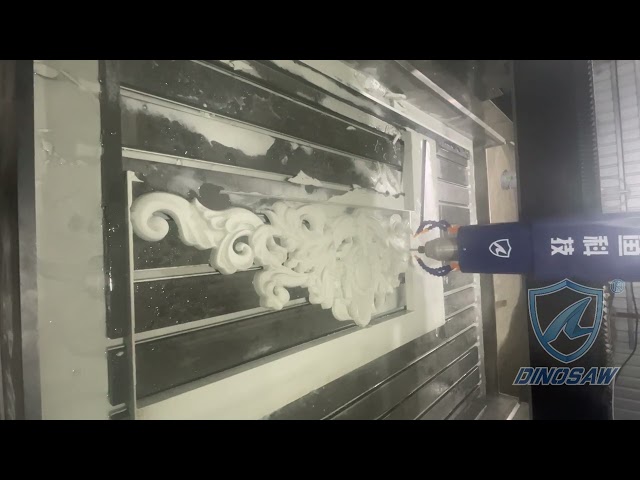
Foam ceramic relief engraving case study using a CNC engraving machine, showing how decorative relief patterns and architectural details are carved with clarity and consistency.
 ▶
▶Case Snapshot
Material
Foam ceramic
Processing Method
CNC engraving and relief carving
Typical Application
Decorative foam ceramic relief panels and architectural ornaments
Applicable Markets
Architectural decoration, façade elements, interior and exterior ornamental components
Processing Focus
Controlled relief carving with clear depth definition and consistent surface texture
Associated Product
CNC engraving machine by Dinosaw Machinery
Foam ceramic reliefs are widely used in architectural decoration, including façade ornaments, decorative panels, corbels, and interior feature elements.
These reliefs often feature layered patterns, flowing curves, and recessed details that create visual depth once installed on buildings or decorative surfaces.
Unlike flat cutting or profile shaping, relief engraving directly defines the surface appearance of the final product.
Any inconsistency in depth, edge clarity, or surface texture becomes visible under natural light, making engraving quality a critical factor in foam ceramic decorative applications.
Relief engraving in foam ceramic introduces challenges different from cutting or profiling.
The material is lightweight and easy to remove, but surface damage can occur if tool movement is unstable.
Relief patterns often include fine details and gradual depth transitions.
Uneven engraving can blur edges or flatten intended textures.
Maintaining consistency across multiple panels is essential when relief elements are installed as a series.
From the workshop’s point of view, relief work leaves no place to hide mistakes.
Cutting errors can sometimes be corrected, but engraving marks stay on the surface.
If the tool movement is not smooth, the relief loses its sharpness immediately.
CNC engraving allows precise control over depth and tool paths.
This is important for relief patterns where layers and transitions define the design.
For foam ceramic, controlled engraving produces clean details without tearing the surface.
Operators focus on tool stability and movement consistency.
They watch how the tool behaves in tight curves and deep recesses, where defects usually appear first.
Surface feel and visual clarity matter more than cutting speed in relief work.
Quality is judged by visual depth, edge clarity, and surface uniformity.
If the relief pattern appears clean, well-defined, and consistent across panels, the engraving is considered acceptable.
Panels that can proceed directly to coating or installation meet workshop expectations.
Foam ceramic panels were securely fixed to prevent movement during engraving.
Predefined engraving paths guided the CNC machine through layered relief patterns.
The process emphasized stable tool movement and controlled depth transitions.
After engraving, panels were visually inspected for detail clarity before moving to finishing or installation stages.
Finished relief panels showed clear patterns and consistent depth definition.
Surface texture remained uniform across engraved areas.
Multiple panels produced under the same process aligned visually when installed together.
The engraving workflow integrated smoothly into architectural decoration production.
If you are producing foam ceramic relief panels or decorative architectural ornaments,
if your projects rely on surface detail and layered visual depth,
if engraving quality affects the final decorative appearance,
this case reflects a practical processing scenario commonly seen in foam ceramic relief fabrication.
 English
Get A Easy Solution
Chat Online
Hi, this is Lizzy from Dinosaw ( Not a Robot ). Which Machine ( model ) do you want? Please WhatsApp us now
Hello 👋 How can we help?