



 中文
中文 Italian
 Türkçe
 Português
 Español
 Deutsch
 العربية
 Tiếng Việt
 Français
 Русский
 한국어
한국어


Ms.Lizzy
Hi, this is Lizzy from Dinosaw ( Not a Robot ). Which Machine ( model ) do you want? Please WhatsApp us now


Open Hours:8:30am-20:30pm

WhatsApp: +86 198-5901-3937

 May 19, 20255 MIN READ
 May 19, 20255 MIN READ
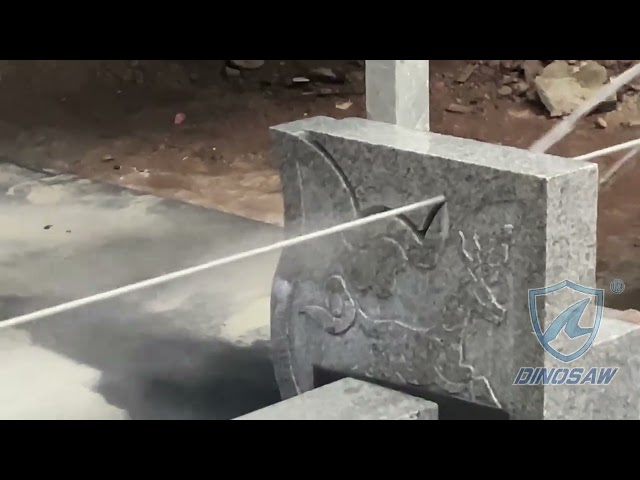
Granite memorial stone cutting case study using CNC wire saw, showing how shaped profiles and clean edges are achieved for memorial and monument production.
 ▶
▶Case Snapshot
Material
Granite
Processing Method
CNC wire saw contour and profile cutting
Typical Application
Granite memorial stones and monument components
Applicable Markets
Memorial fabrication, stone monument workshops, customized stone products
Processing Focus
Accurate shaping and clean edge control for memorial stone profiles
Associated Product
DINOSAW CNC wire saw machine for monument
Granite memorial stones are typically produced as customized stone products rather than standardized building materials.
They often include shaped outlines, stepped edges, or curved details that define the visual character of the final monument.
In memorial fabrication, the cut shape itself is part of the finished appearance.
Any inaccuracy introduced during cutting becomes difficult to correct later, even with polishing.
For this reason, cutting is treated as a defining stage in the production process rather than simple material preparation.
Cutting granite for memorial use presents a specific set of workshop challenges.
Granite is hard and dense, making it sensitive to cutting stability when profiles change direction.
Memorial stones often require both straight and curved sections within the same piece.
Surface marks left during cutting may remain visible after finishing.
Consistency becomes important when multiple components must match as part of a single monument.
From the workshop point of view, memorial stones are less forgiving.
With slabs or blocks, minor imperfections may be hidden later, but memorial pieces are viewed up close.
If the outline is not clean, it shows immediately in the finished monument.
Wire saw cutting allows the profile to be followed smoothly, especially where curves and transitions are involved.
Instead of forcing the stone through a rigid path, the wire adapts to the intended shape.
This makes it easier to maintain clean outlines on detailed memorial designs.
Operators focus on stability throughout the entire cut.
They watch how the wire behaves at corners and transitions, since those areas define the final shape.
Any vibration or hesitation is taken seriously, because it often leaves marks that cannot be polished out.
Quality is judged by the clarity of the profile and the condition of the edges.
If the memorial stone can proceed directly to engraving or polishing without reshaping, the cut is considered acceptable.
Visual consistency is a key benchmark in memorial production.
Granite blocks were positioned and secured to support stable cutting along defined memorial profiles.
Predefined contours guided the wire saw through straight lines and curved sections in a continuous motion.
The cutting process emphasized smooth progression rather than speed.
After cutting, memorial stone components were visually inspected before moving to engraving or finishing stages.
Finished memorial stones showed clean outlines and well-defined profiles.
Edges remained intact and suitable for detailed engraving work.
Multiple pieces produced under the same process remained visually consistent.
The cutting approach integrated smoothly into routine memorial stone fabrication.
If you are producing granite memorial stones or monument components,
if your work involves shaped profiles rather than simple straight cuts,
if visual quality and profile accuracy are critical in the final product,
this case reflects a practical processing scenario commonly seen in memorial stone workshops.
 English
Get A Easy Solution
Chat Online
Hi, this is Lizzy from Dinosaw ( Not a Robot ). Which Machine ( model ) do you want? Please WhatsApp us now
Hello 👋 How can we help?