





 中文
中文 Italian
 Türkçe
 Português
 Español
 Deutsch
 العربية
 Tiếng Việt
 Français
 Русский
 한국어
한국어


Ms.Lizzy
Hi, this is Lizzy from Dinosaw ( Not a Robot ). Which Machine ( model ) do you want? Please WhatsApp us now


Open Hours:8:30am-20:30pm

WhatsApp: +86 198-5901-3937

 Oct 30, 20255 MIN READ
 Oct 30, 20255 MIN READ
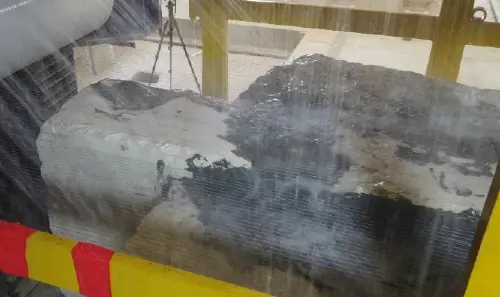
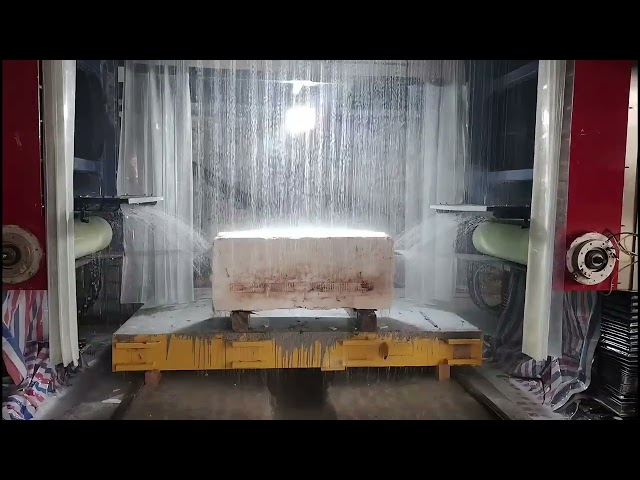
Marble slab cutting case study using a CNC multi-wire saw, showing efficient high-volume slab production with clean surfaces and minimized material waste.
 ▶
▶Case Snapshot
Material
Marble
Processing Method
CNC multi-wire saw slab cutting
Typical Application
Batch marble slab production for architectural and interior stone panels
Applicable Markets
Stone fabrication, architectural stone panel production, slab supply for construction
Processing Focus
Efficient and consistent slicing of large marble blocks into uniform slabs
Associated Product
CNC multi-wire saw machine by Dinosaw Machinery
In stone fabrication, turning large marble blocks into slabs is a foundational step for the rest of production, whether for flooring, countertops, wall cladding, or furniture elements.
Multi-wire saw machines are designed to cut multiple parallel slices from a single block in one setup, enabling higher throughput and better material utilization compared with traditional gang saw methods.
Modern multi-wire saw machines combine CNC controls with diamond wire cutting technology to achieve narrow kerf cutting, which reduces material loss and preserves more of the valuable stone pattern and surface.
In workshops handling premium marbles, higher yield and consistent slab quality directly affect profitability and downstream finishing processes.
Batch slab cutting introduces several real-world challenges in workshop settings.
Marble blocks often vary in density and internal structure, which can make maintaining consistent cut quality across dozens of parallel wires difficult.
Thin slabs demand stable cutting conditions; any vibration or tension fluctuation shows up as variation in thickness or surface quality.
High-volume cutting requires reliable tension control of multiple diamond wires simultaneously — a task that historically was difficult with older mechanical systems.
In marble slab production, the scale is what changes everything.
You’re not cutting a single piece — you’re slicing dozens of layers at once.
If one wire goes out of sync, you can see it across the whole batch.
That’s why operators always emphasize stable cutting rhythm and tension balance — inconsistency anywhere affects consistency everywhere.
Multi-wire saws let you cut many slabs in one run without repositioning the block.
With traditional gang saws, you often lose a lot of material in the saw kerf and need extra finishing.
Diamond wires with narrow kerf and synchronized motion mean you get more usable slabs from each block, and the surface comes off much smoother right out of the machine.
Operators watch the wire tension and how the slab surfaces look as they come out of the cut.
Temperature and coolant flow are also key — if the stone heats unevenly, one wire can lag behind another.
It’s not just “turn it on and wait”; good operators listen to the machine and see how each slab behaves as it emerges.
On the workshop floor, quality is judged by how even the slab thickness is and how clean the surfaces look.
If slabs stack without noticeable variation and the faces are smooth enough for finishing without extra flattening, the cut is considered successful.
Large marble blocks were loaded and secured to prevent movement during cutting.
The multi-wire saw system was set to slice the block into multiple slabs in one continuous operation.
Predefined cutting paths and tension settings guided the diamond wires so that each blade moved in synchronization.
Cuts were monitored for tension balance and surface quality.
After slicing, slabs were inspected and then transferred for finishing processes.
Finished marble slabs showed uniform thickness and consistent surface quality suitable for subsequent finishing.
Because the kerf was narrow and the cut surfaces smooth, many slabs required minimal flattening or polishing before finishing.
Multiple slabs produced from the same block aligned well in thickness, simplifying handling and reducing downstream adjustment time.
The cutting approach fit naturally into routine slab production in busy stone fabrication workshops.
If you are cutting marble blocks into finished slabs in high volumes,
if surface quality and slab consistency affect your finishing and installation workflows,
if material yield and minimizing waste are priorities in your production,
this case reflects a practical slab cutting scenario commonly seen in marble fabrication.
 English
Get A Easy Solution
Chat Online
Hi, this is Lizzy from Dinosaw ( Not a Robot ). Which Machine ( model ) do you want? Please WhatsApp us now
Hello 👋 How can we help?