


Dimensional Block Extraction
Cut dimensional blocks from the bench with wire precision: no blast fractures, clean cut faces, full-value stone to the cut line.


Open Hours:8:30am-20:30pm

WhatsApp: +86 198-5901-3937
Applicable Materials
Marble, granite and dimension stone in open quarries
Certifications & Credentials
CE Certified · ISO 9001:2015 · Industry Standard Drafting Participant · 120+ Countries & Regions Served
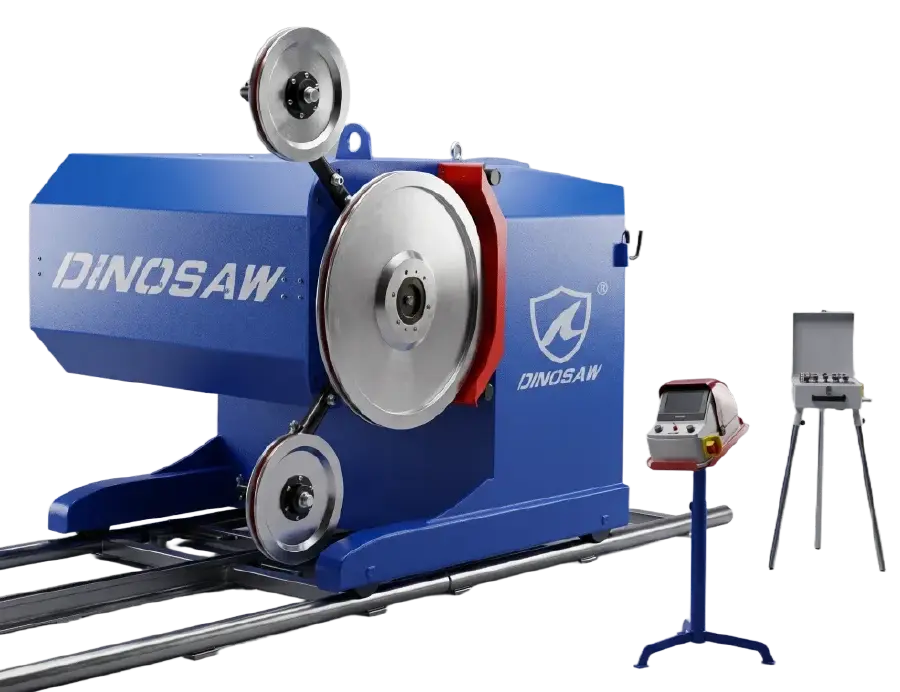
Quarry wire saws extract dimensional blocks from the bench — the cutting stage that decides block value, yield and the economics of everything downstream.
Cut dimensional blocks from the bench with wire precision: no blast fractures, clean cut faces, full-value stone to the cut line.
The KSSJ-M series at 0–50 m/s covers marble's free-cutting behavior, from M37 on small benches to M90 on deep programs.
The KSSJ-G series carries up to 110 kW at granite's lower, controlled 0–30 m/s wire speeds for hard, abrasive stone.
The crawler configuration cuts where rails do not reach, relocating between positions under its own power.
Extract true-dimensional blocks that downstream multi-wire saws and block cutters convert to slabs with minimal waste.
The KSSJ-M/G quarry wire saw machine combines a permanent magnet drive, three-inverter constant-tension control and quarry-proven automatic software in stand-type or crawler configurations — cutting marble and granite blocks at the power class the bench demands.
Marble models run 37–90 kW and granite models 37–110 kW: the power class follows the stone, not the other way around.
Three brand inverters with PLC and real-time current tracking hold wire tension constant through the cut — more efficient cutting and longer wire life.
The permanent magnet motor starts with high pulling torque at low current, wastes less energy, runs cooler, and doubles motor life at the lower working temperature.
The rail-mounted stand type serves established benches with rail infrastructure; the KSSJ-37M-E / 55M-E / 75M-E crawler family moves forward, backward and turns without laying guide rails, with 360° head flipping and IoT online monitoring.
Applicable materials: Marble, granite and dimension stone in open quarries.
Typical applications: Dimensional block extraction, bench cutting, block squaring at the quarry face and primary cutting ahead of trimming and slabbing.
Actual cutting speed varies with stone hardness, wire specification, tension settings and quarry conditions.
Marble stand-type models KSSJ-M37 to M90 run wire lengths of 20–160 m at 0–50 m/s with 37–90 kW main motors; granite stand-type models KSSJ-G37 to G110 run 20–180 m wire at 0–30 m/s with 37–110 kW. The crawler family KSSJ-37M-E / 55M-E / 75M-E carries 37 / 55 / 75 kW main motors with maximum cut spacing of 1,750 / 1,950 / 2,100 mm, rail-free walking under PLC control, 360° head flipping, cutting linear speed to 38 m/s and IoT remote monitoring.
| Stand type (rail) | Main motor (kW) | Wire length (m) | Line speed (m/s) | Max cut spacing (mm) |
| KSSJ-M37 / G37 | 37 | 20–80 | 0–40 / 0–30 | — |
| KSSJ-M45 | 45 | 20–100 | 0–40 | — |
| KSSJ-M55 / G55 | 55 | 20–120 | 0–40 / 0–30 | — |
| KSSJ-M75 / G75 | 75 | 20–150 | 0–50 / 0–30 | — |
| KSSJ-M90 / G90 | 90 | 30–160 | 0–50 / 0–30 | — |
| KSSJ-G110 | 110 | 40–180 | 0–30 | — |
| Crawler | Main/total power (kW) | Max cut spacing (mm) | Head flip | Mobility |
| KSSJ-37M-E | 37 / 40 | 1750 | 360° | Rail-free, PLC walking |
| KSSJ-55M-E | 55 / 58 | 1950 | 360° | Rail-free, PLC walking |
| KSSJ-75M-E | 75 / 79 | 2100 | 360° | Rail-free, PLC walking |
Four engineering decisions behind the KSSJ quarry platform. The numbered points on the machine diagram correspond to the systems below.
An extraction cycle follows four steps: drill the access holes and thread the wire, anchor the machine on rails or position the crawler, run the automatic cutting program with constant tension control, then separate and load the block — parameters store per bench for repeat cycles.
The permanent magnet motor delivers high pulling torque from standstill at near-zero rotor current: less energy wasted as heat, a cooler-running motor, and doubled motor life from the lower working temperature — a real advantage on benches where the drive starts and stops under load all shift.
Torque stays constant across the whole frequency range, especially at low frequencies where conventional drives sag: the wire keeps pulling hard at low speed, startup under load is easier, and energy draw stays efficient across the cut.
Three brand inverters with PLC, digital communication and real-time current tracking hold diamond wire tension constant through changing stone resistance: the wire cuts efficiently instead of wandering or overloading, and wire life extends as a direct result.
The fully automatic control software has been fine-tuned in quarries over years, with multi-language digital display and parameter storage: cutting parameters become stored, repeatable programs instead of operator memory, and shift-to-shift consistency follows.
The rail-mounted stand type anchors to quarry rails for guided, repeatable passes on established benches; the crawler configuration relocates under its own power where rails do not reach — one cutting system, two deployment logics, chosen by bench layout.
The rail-mounted stand type anchors to quarry rails for guided passes on established benches. The crawler family KSSJ-37M-E / 55M-E / 75M-E walks forward, backward and turns without laying guide rails under PLC walking-speed control, flips its head through 360 degrees, cuts to 38 m/s and reports machine condition through an IoT remote-monitoring system — one cutting system, two deployment logics, chosen by bench layout.
An extraction-method comparison for dimensional stone quarries.
DINOSAW is a manufacturer of CNC stone processing machinery, specializing in diamond wire saw machines and CNC stone cutting equipment. With more than 20 years of R&D and manufacturing experience, DINOSAW contributes to industry standards including T/CMES 41001-2025 for CNC wire saw machines, holds 100+ technical patents, and supplies equipment and technical support to customers in 120+ countries and regions. Its manufacturing and management systems are certified to ISO 9001, ISO 14001 and ISO 45001, with CE-compliant machinery for international markets.
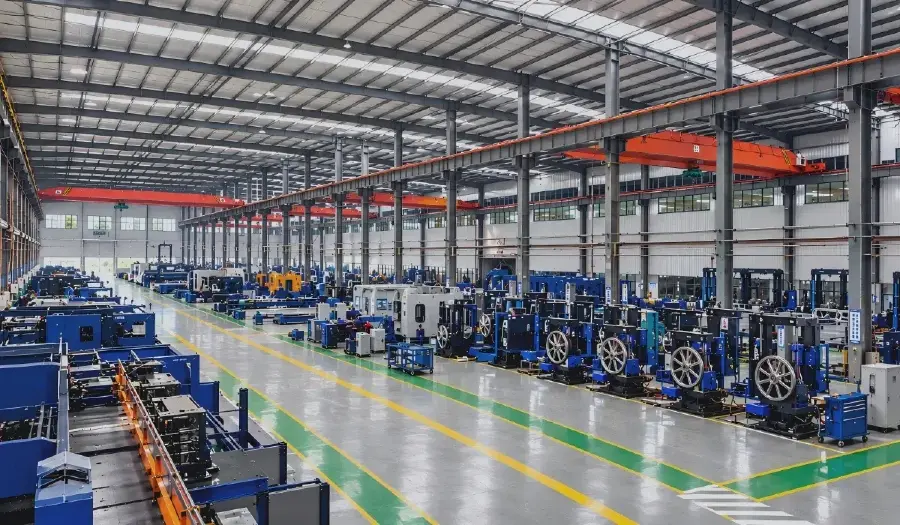
DINOSAW provides installation guidance, operator training, remote diagnosis and spare-parts coordination for every machine.
Configuration follows the bench layout; crawler positions without rails.
Voltage and frequency confirmed against local standards before shipment.
Wire cooling and slurry management at the quarry face.
Marble vs. granite model selection, stand vs. crawler configuration, and the permanent magnet advantage on the bench.
Choose by stone class first, then by program size. The two families are engineered for different cutting physics: marble models KSSJ-M37 to M90 run wire speeds to 40–50 m/s because marble cuts freely and rewards speed; granite models KSSJ-G37 to G110 run controlled 0–30 m/s with higher torque because hard, abrasive granite punishes aggressive settings. Within each family, size by wire length and bench depth: a 20–80 m wire class (M37/G37) serves shallow benches, while the 150–180 m classes (M75/M90/G90/G110) cover deep extraction programs. Match the motor to the hardest stone you regularly cut — a quarry that mixes marble and granite usually sizes on the granite class and runs marble within its parameters. Send the stone classes and bench depths for a configuration review. Wire length class matters as much as power: deep benches need the 150–180 m classes even when the motor size looks sufficient. Confirm the bench depth with the quarry survey before finalizing the wire class.
When the bench cannot host rails, choose the crawler. The stand type anchors to quarry rails and gives the most guided, repeatable passes — the right choice on established benches with rail infrastructure. The crawler family KSSJ-37M-E, KSSJ-55M-E and KSSJ-75M-E carries the same permanent magnet cutting system on a self-propelled base that walks forward, backward and turns without laying guide rails, under PLC walking-speed control with constant-current cutting. The head flips through 360 degrees for access to any cutting plane, cutting linear speed reaches 38 m/s, and an IoT system reports operating data remotely in real time. Main motors run 37 / 55 / 75 kW with total power 40 / 58 / 79 kW and maximum cut spacing of 1,750 / 1,950 / 2,100 mm. The crawler trades the rail's absolute guidance for positioning freedom — development faces, irregular geometry and railless benches. Many quarries run stand types on developed benches and add a crawler for development work.
Three measurable returns: cut efficiency, wire life and predictability. The KSSJ's three inverters with PLC and real-time current tracking hold wire tension constant as stone resistance changes through the cut — without it, the wire drifts out of its working window, cuts slower, deviates from the line or overloads and fails. With constant tension, the wire stays in its efficiency zone: cutting progresses at the intended rate, wire consumption per square meter drops, and unplanned wire breaks — the most expensive interruption in quarry cutting — become rare events instead of routine ones. Add the quarry-proven automatic software storing parameters per bench, and shift-to-shift variation leaves the operation: the first cut of Monday morning runs the same as the last cut of Friday. Track square meters per wire per bench as the baseline that proves it. The multi-language display and parameter storage mean a bench program survives operator changes, which matters more than any single feature in multi-shift quarries.
Because quarry duty is hardest on motor starts and heat. The permanent magnet motor produces high pulling torque from standstill at near-zero rotor current: less energy is wasted as heat, the motor runs cooler, and the catalog states motor life doubles at the lower working temperature. Torque stays constant across the whole frequency range — especially at low frequencies, where asynchronous drives sag and the wire slows under load — so low-speed cutting keeps pulling hard and startup under load is easier. For a machine that starts, stalls against stone, and restarts repeatedly through every shift, those are exactly the failure modes that shorten motor life, and the permanent magnet design is engineered against them. The energy saving is real but secondary; the durability is the point. Quarries report the cooler-running motor as the difference between mid-season motor replacements and motors that outlast the wire inventory. The differential-simulation heat design is what keeps the electronics alive through summer bench conditions.
Contact Dinosaw
Discuss KSSJ Quarry Wire Saw ConfigurationAre you looking for the perfect cutting machines or processing solutions for hard and brittle materials?
Facing challenges in stone quarrying, countertop cutting, concrete and underwater pipeline cutting, stainless steel rust removal and grinding, luxury thin slab cutting, agate and gemstone cutting, graphite cutting, or even building demolition?
Leave your inquiry, and you can expect a reply within 12 hours with tailored solutions!






What materials will you be working with? *
Your Name / Company Name? *
Phone Number / Email Address? *
What specific requirements do you have?
Selection guides and related equipment for quarry extraction, block cutting and mining.
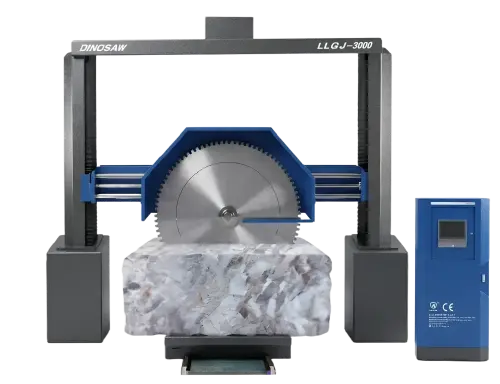
The DBM opens straight vertical faces at production pace - a complementary extraction machine on the same bench.
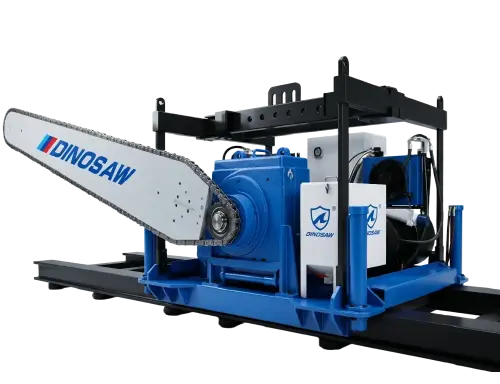
The LBJ chain saw dry-cuts straight soft-stone faces where wire sawing is uneconomical - the high-bench partner.

DTH drilling prepares blast and pre-splitting holes that release wire-cut blocks.
 English

Get A Easy Solution
Chat Online
Hi, this is Lizzy from Dinosaw ( Not a Robot ). Which Machine ( model ) do you want? Please WhatsApp us now
Hello 👋 How can we help?


 中文
 Italian
 Türkçe
 Português
 Español
 Deutsch
 العربية
 Tiếng Việt
 Français
 Русский
 한국어
