Every Kerf Is a Cost. Every Batch Has to Hold.

For crystal material processors and substrate manufacturers, the economics of slicing are straightforward: the more usable substrate you recover from each ingot or boule, and the less rework you generate in downstream lapping and polishing, the lower your cost per wafer. The cutting stage is where both of those variables are set.
Silicon ingots, SiC boules, sapphire crystals, and quartz glass blanks are not cheap raw materials, and they are not getting cheaper. At the same time, the quality specifications for the substrate coming out of slicing — TTV, surface roughness, subsurface damage depth — are getting tighter as device requirements advance. The cutting process has to deliver on both fronts: material yield and output quality, consistently, across every production run.

Kerf Loss on Expensive Material

On SiC and sapphire, raw material cost per unit volume is high enough that the difference between a 0.35mm kerf and a 0.5mm kerf, multiplied across a production run, is a meaningful cost variable. Wire diameter selection and cut parameter optimisation directly determine how many usable substrates come out of each boule or ingot.

Kerf Loss on Expensive Material

On SiC and sapphire, raw material cost per unit volume is high enough that the difference between a 0.35mm kerf and a 0.5mm kerf, multiplied across a production run, is a meaningful cost variable. Wire diameter selection and cut parameter optimisation directly determine how many usable substrates come out of each boule or ingot.

Slicing, Profiling, and Grinding for Substrate Production

We provide diamond wire saw cutting and surface grinding across the full substrate processing sequence — from ingot and boule slicing through cropping and profile cutting to post-cut damage removal and thickness control. Each configuration is set to the specific material, substrate geometry, and quality specification of the production scope.

Narrow Kerf, More Substrates per Ingot

Wire diameters from 0.35mm produce cutting widths well below blade-based alternatives. On high-cost materials like SiC and sapphire, the additional substrates recovered per boule from narrower kerf directly offset the cost difference between cutting methods across a production run.

Controlled SSD for Lower Polishing Cost

Cutting parameters — wire tension, feed rate, speed — are set to minimise the subsurface damage depth introduced during slicing. Shallower SSD means less material to remove in lapping and polishing, shorter downstream cycle times, and more of the substrate thickness remaining after finishing.

TTV Stability Across the Production Run

Wire tension stability, feed rate consistency, and systematic wire wear monitoring maintain TTV across the full batch — not just the first few wafers. Wire wear is tracked and managed so that cut quality at the end of a production run matches the beginning, preventing late-batch variation from creating rejection events in otherwise clean production.

Post-Cut Grinding for Thickness and Flatness

Post-slice surface grinding removes the cut damage layer and brings substrates to target thickness and flatness for downstream polishing and epitaxial processing. Controlled material removal reduces CMP stock and polishing cycle time, improving overall process yield across the production line.

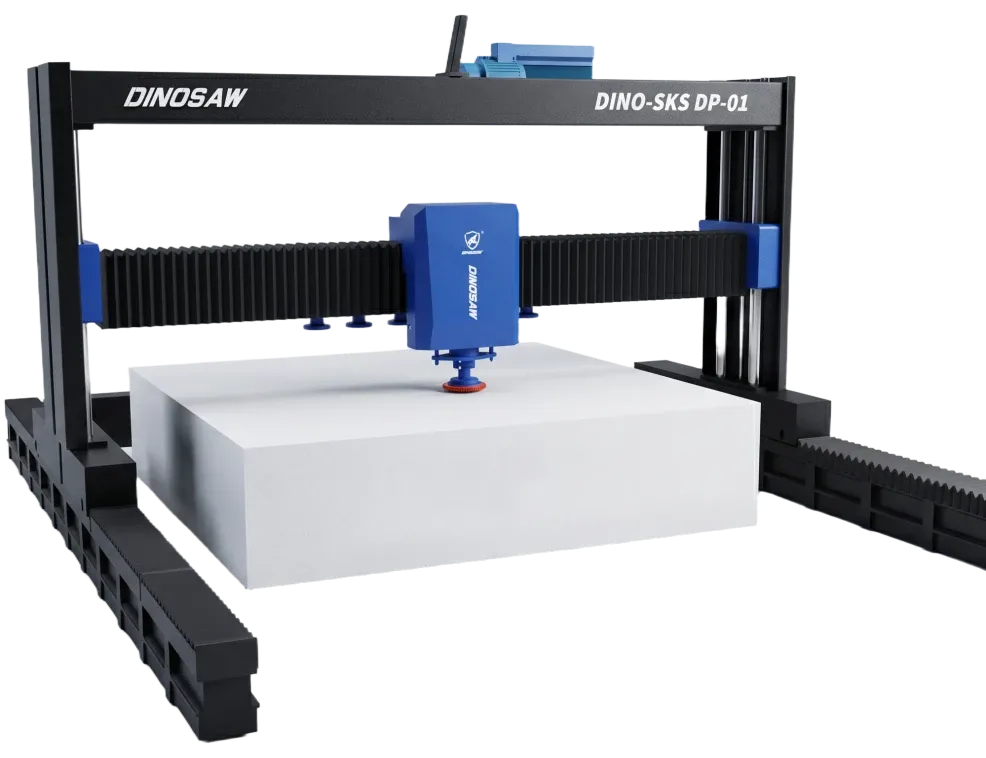
Dinosaw Machines for Semiconductor Material Processing

We work across three system types for semiconductor substrate processing. Configuration to material type, substrate geometry, production volume, and quality specification is part of every engagement — not a standard setup applied without adjustment.

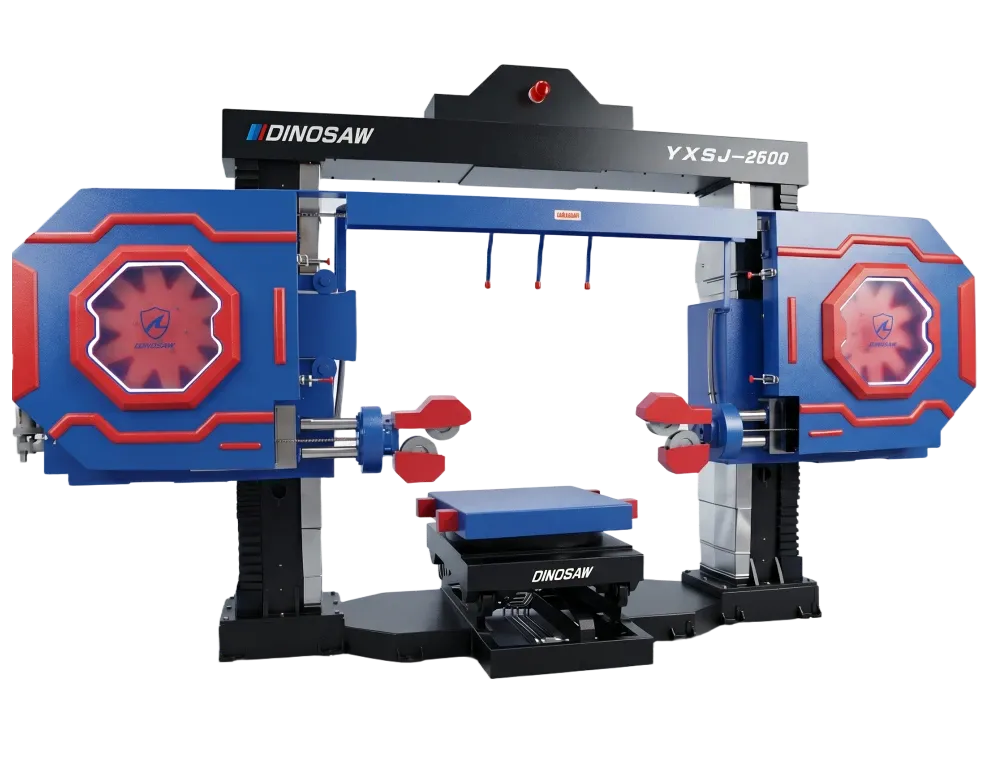
CNC Wire Saw — Large-Format Ingot and Boule Processing

Our CNC diamond wire saw series is our primary system for semiconductor substrate production — covering the range from laboratory precision cutting to high-volume ingot and boule slicing. This is the system for large-format rough blank processing: turning silicon ingots, SiC boules, and sapphire crystals into substrate-ready slices at production volume.
The wire saw series operates across a wide workpiece size range, accommodating ingot diameters and boule lengths typical of commercial substrate production. Wire diameter selection from 0.35mm enables narrow kerf cutting to maximise substrate yield from high-cost crystal materials. CNC control delivers consistent feed and tension throughout the cut, maintaining TTV stability across the batch and from batch to batch.
Available configurations span from compact single-wire precision systems for small-batch and research-adjacent production, through to larger-format multi-axis systems for high-volume runs. 

View Wire Saw Machines

Ring Abrasive Wire Saw Machine — Dicing, Circular Cutting, and Profiling

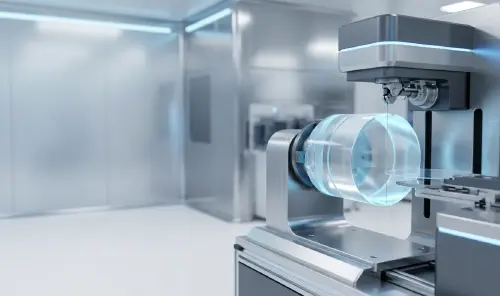
Ring abrasive wire systems use a continuous wire loop for high-precision, low-vibration cutting of semiconductor and optical materials. Three configurations address different production tasks.
Slicing configuration: for wafers and thin substrates from blocks or ingots — alumina single-crystal sheets, silicon wafers, optical glass, graphite, and abrasive wheel sectioning. Wire diameter from 0.35mm.
Circular cutting configuration: for round cross-sections from cylindrical workpieces — optical glass, crystalline SiC, and graphite components requiring circular or disc-form output.
Contour profiling configuration: for complex non-standard geometries — graphite, crystal profiling, aerospace composites, and advanced ceramics requiring curved or compound-path cuts.

Discuss Wire Saw Configuration

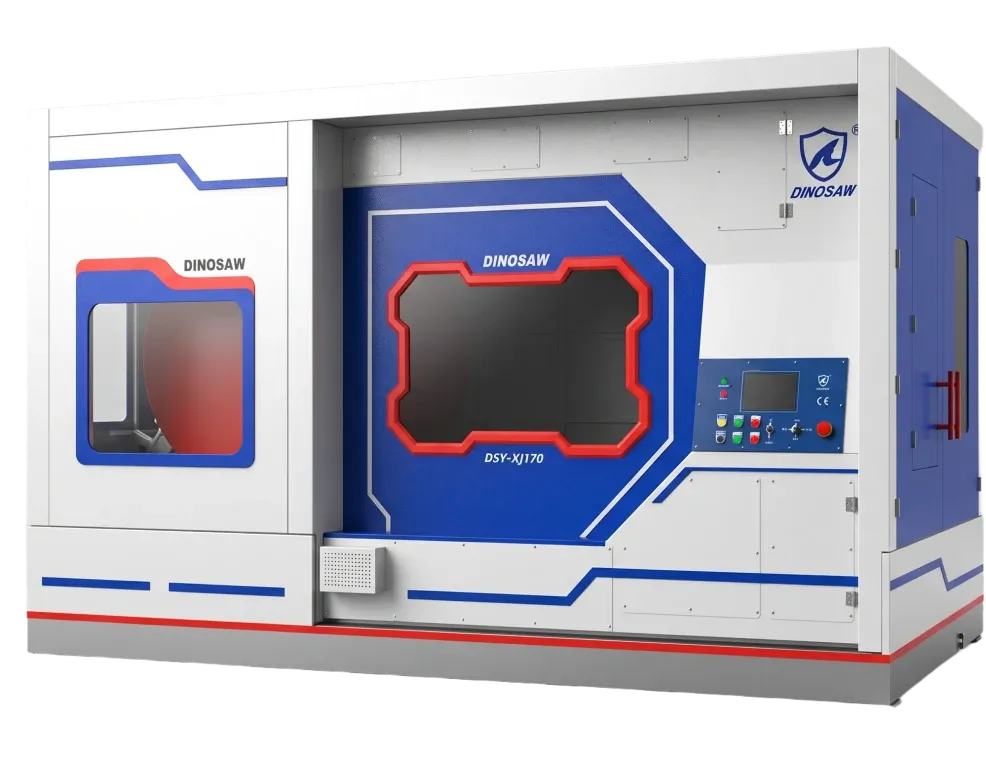
Surface Grinding Machine — Post-Cut Thinning and Damage Removal

Post-slice surface grinding removes the cut damage layer, brings substrates to target thickness, and produces the flatness required for downstream polishing and epitaxial growth. Our vertical-spindle rotary-table setup delivers flat, uniform surfaces with controlled material removal across the full substrate face.
Suited to batch processing of substrates to defined thickness and TTV targets. Reduces CMP stock and polishing cycle time across the production line. Materials include silicon, SiC, sapphire, quartz glass, and technical ceramics — parameters set per material to balance damage removal rate against surface quality.

View Grinding & Polishing Machine Details

How Dinosaw Machinery Works With You

Dinosaw doesn't supply off-the-shelf equipment. Every system is scoped, engineered, and commissioned for the specific project it's built for. Here is what that process looks like, and who Dinosaw works with.

How a Project Engagement Works

01

Initial Discussion

We start with your requirements: materials to be processed, production targets, site conditions, and timeline. A direct engineering conversation — not a standard questionnaire.

02

Specification Development

Based on the discussion, we develop an equipment configuration: machine type, dimensions, tooling, control architecture, and interface requirements specific to your application.

03

Engineering Review & Iteration

The specification is shared with your technical team for review. We work through comments and refine the design before any build commitment is made.

04

Build & Quality Documentation

In-house fabrication with full quality documentation produced throughout. Documentation package provided on delivery to support your acceptance processes.

05

Commissioning, Training & Ongoing Support

On-site commissioning to verify performance against specification. Operator training for your team. Ongoing technical support throughout the equipment lifecycle.

Our Capabilities

In-House Manufacturing

We design and fabricate our equipment in-house, with direct control over engineering changes, fabrication sequences, quality documentation, and lead time — critical when your project programme cannot absorb supplier delays.

R&D Engineering Team

Our engineers work directly from your project brief. We build the specification from your site conditions, material profile, and processing requirements — then iterate with your technical team before confirming the build.

Project-Specific Configuration

No two systems we build are identical, because no two projects are. Each machine is configured — not adapted — to your specific material, geometry, production volume, and operational requirements.

On-Site and Remote Support

We provide commissioning support, operator training, and ongoing technical assistance for every system we supply. For international projects, we coordinate through detailed documentation, remote diagnostics, and planned site visits aligned with your programme schedule.

Who We Work With

End Users & Manufacturers

Factories, processing plants, and industrial operators who need machinery for their own production — whether for a specific material, a new production line, or an upgrade to existing capacity. We work with you from requirement to running machine.

Distributors & Agents

Regional distributors and agents representing Dinosaw Machinery in local markets. We provide technical support, product documentation, and co-development of market-specific solutions to help you serve your customers effectively.

Engineering Consultancies

Consultancies developing equipment specifications, feasibility studies, or technology assessments for industrial projects. We provide technical data, application references, and direct engineering input to support your work.

Whether you are specifying equipment for a new project, exploring options at feasibility stage, or looking for a manufacturing partner for a specific application — we are ready to have that conversation.
大鲨鱼机械Lizzy黄
硬脆材料加工专家 / 销售主管
扫码即刻沟通
点击二维码添加微信
获取精密机械加工方案及报价

Get A Easy Solution

Chat Online
Ms.Lizzy

Hi, this is Lizzy from Dinosaw ( Not a Robot ).  Which Machine ( model ) do you want? Please WhatsApp us now

WhatsApp Chat Now
Contact Us

Hello 👋 How can we help?