


 中文
中文 Italian
 Türkçe
 Português
 Español
 Deutsch
 العربية
 Tiếng Việt
 Français
 Русский
 한국어
한국어


Ms.Lizzy
Hi, this is Lizzy from Dinosaw ( Not a Robot ). Which Machine ( model ) do you want? Please WhatsApp us now


Open Hours:8:30am-20:30pm

WhatsApp: +86 198-5901-3937

 May 29, 20269 MIN READ
 May 29, 20269 MIN READ
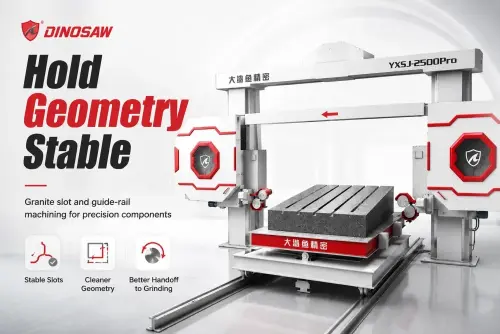
Learn how diamond wire saw preform cutting helps precision granite components, machine bases, and instrument platforms reduce rework and stabilize downstream machining.
In precision granite component production, cutting is not just the first step. It decides how hard the next steps will be.
If the blank is still far from the target shape, everything after cutting gets heavier. Slot machining slows down. Face processing needs more correction. Grinding and final adjustment take longer.
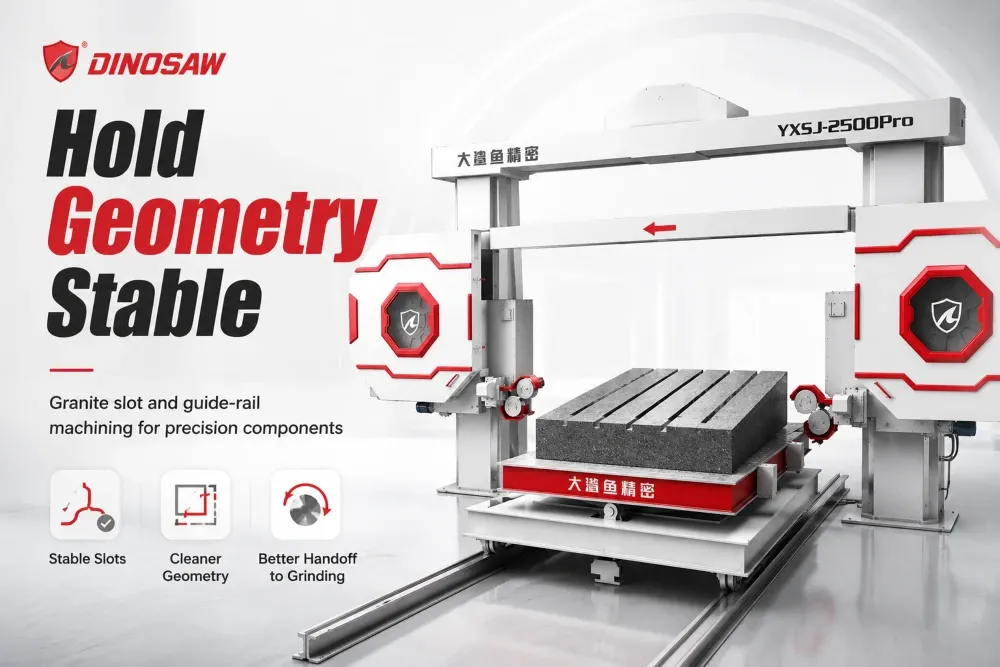
This is why preform cutting matters. A CNC diamond wire saw can shape long slots, step features, and irregular structures earlier. The blank enters later machining with cleaner edges and more stable geometry.
For this type of part, the main question is simple: after the machine enters production, does the line become faster and more stable?
Dinosaw Machine applies this approach to shaped granite blank preparation, where cutting quality directly affects later milling, grinding, slot machining, and final correction.
If you are evaluating preform cutting for granite components, message Dinosaw on WhatsApp with your workpiece geometry and current bottlenecks to check process fit.
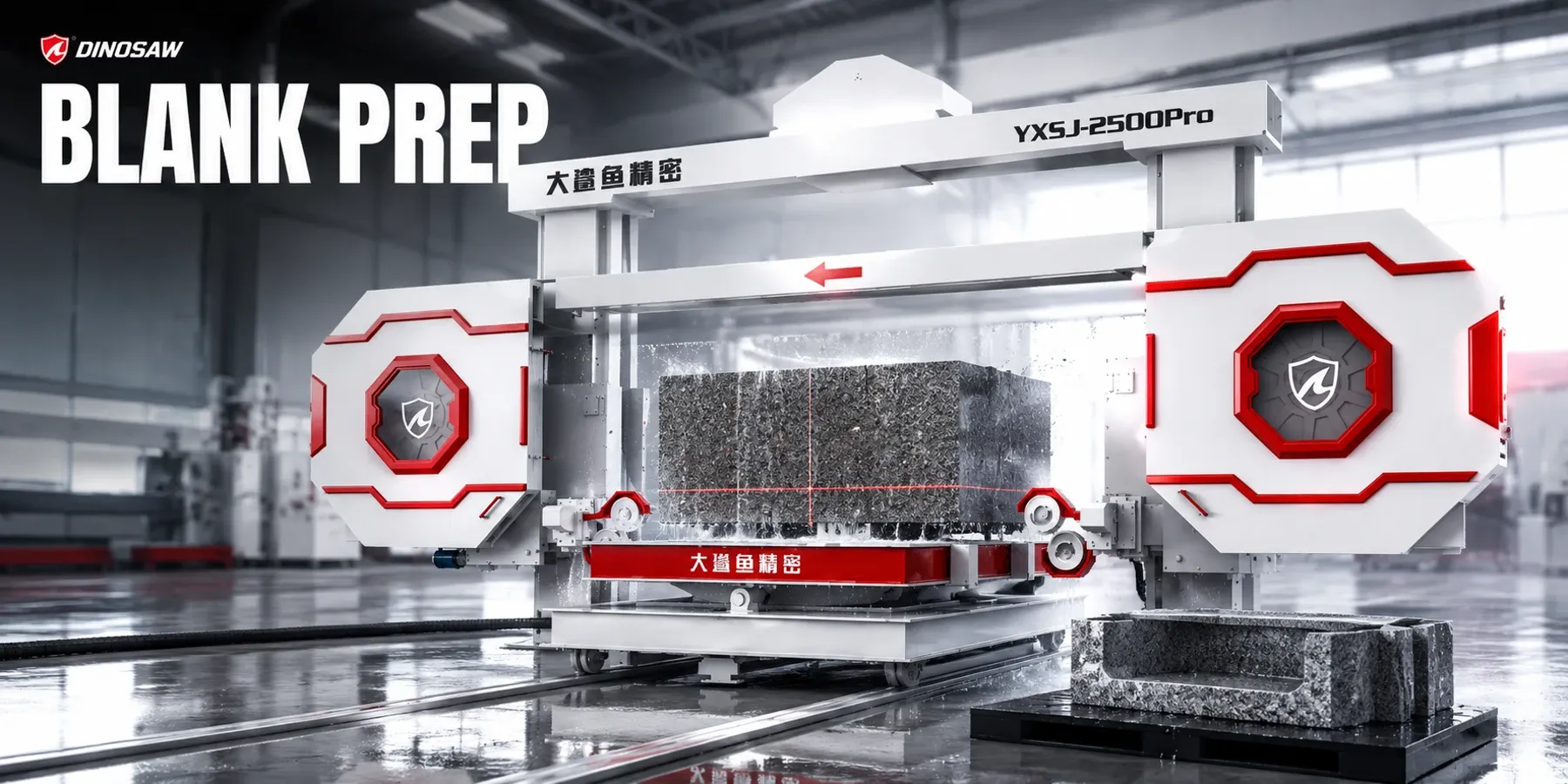
Rough cutting looks simple. In real production, it often creates work for every step after it.
When the blank stays far from final geometry, later operations have to remove more material. They also have to repair edge damage and absorb unstable allowances. That costs time and makes planning less predictable.
In many granite component workflows, rough cutting does not remove cost. It moves cost into milling, grinding, edge correction, and final adjustment.
This problem is larger in precision granite components than in simple slab cutting. Platforms, instrument bases, and measuring bases often include long grooves, step surfaces, and irregular outer shapes. When the blank is off, every later process pays for that error.
So front-end cutting should be treated as process control, not only material separation.
Diamond wire saw preform cutting works better because it brings the blank closer to target shape from the start.
This matters most when geometry is demanding. Long-slot pre-cuts, step features, cavity-avoidance areas, and irregular outer profiles all need flexible path control. A CNC wire saw gives more control at this stage.
Cut quality matters too. A smoother surface and a more stable blank reduce correction in slot machining, face processing, edge grinding, and finishing. So preform cutting is not only about speed. It also lowers process stress before later work begins.
With CNC control and path planning, this stage is easier to standardize. It depends less on operator improvisation and more on a repeatable workflow.
The biggest gains usually appear in parts where blank shape directly affects later machining cost and difficulty.
Common examples include:
For these parts, the blank needs to match the later machining logic more closely from the start. When the cut blank is already closer to the target geometry, the rest of the process becomes easier to control.
This is not the same decision as general stone cutting. It matters most in workflows where cutting quality directly affects machining efficiency, finishing consistency, and production stability.
In practice, the same requirement often appears in granite machine base cutting, granite instrument base cutting, granite platform slot cutting, and other shaped blank preparation jobs.
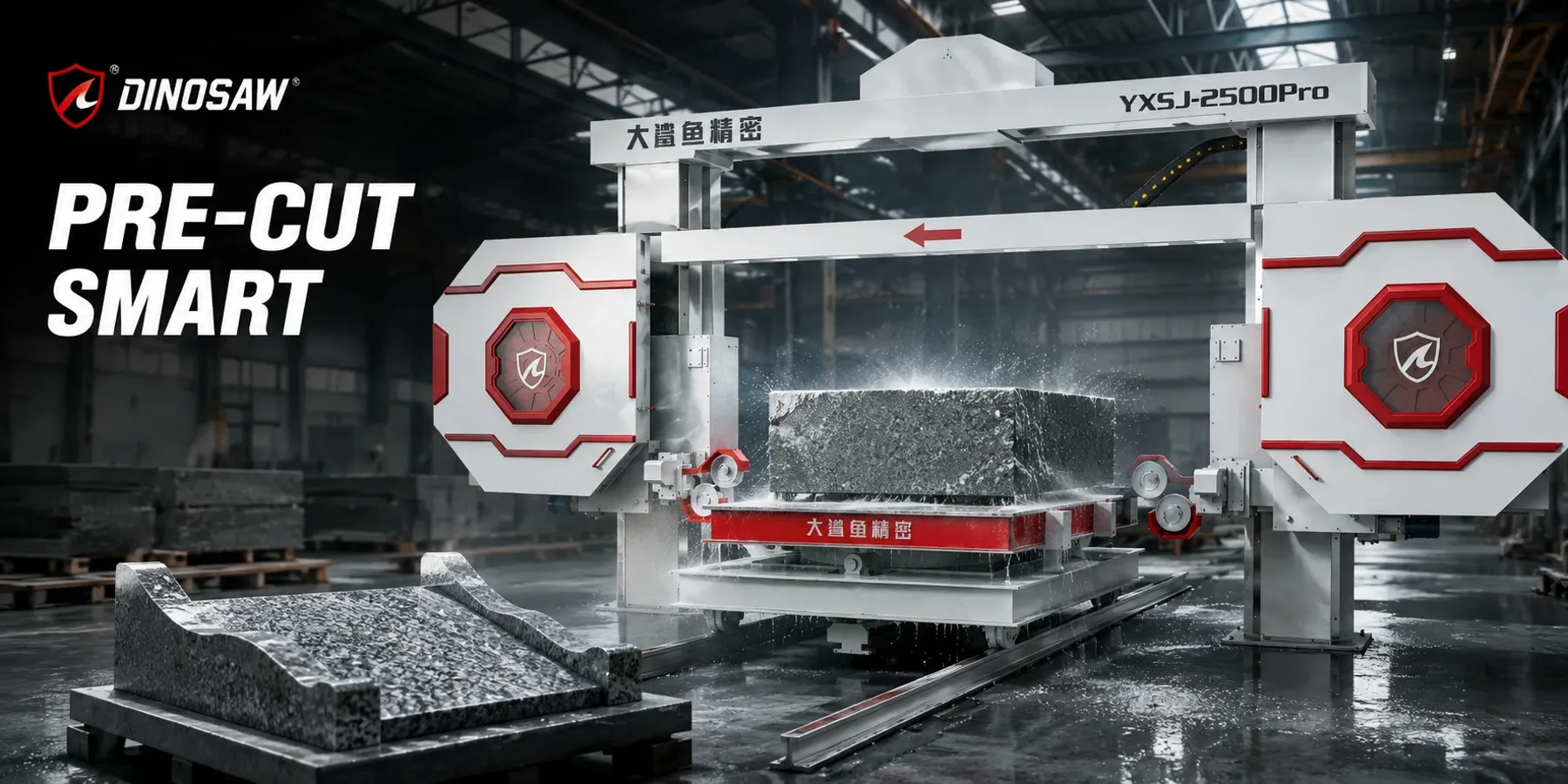
Many suppliers describe a wire saw as precise. For this industry, the better comparison is what the Dinosaw wire saw machine changes on the shop floor after installation.
In comparable precision granite applications, including shaped blanks for machine bases, instrument platforms, and long-slot parts, Dinosaw positions its wire saw solution around cutting speeds up to 2x those of similar equipment, depending on workpiece geometry and process settings. For the factory, this means stronger throughput potential and faster transfer to the next step.
Dinosaw's patented closed-loop rope structure is designed to reduce wire-breakage risk significantly. In suitable applications and operating conditions, reductions can reach up to 95 percent. This matters because breakage affects downtime, consumable stability, schedule reliability, and operator confidence. In production, the result is fewer interruptions during shaped granite blank cutting.
Dinosaw's AI-assisted control system is designed to shorten the learning curve. It helps teams reach stable output faster and reduces dependence on a small number of highly experienced operators.
Together, these points support faster flow to the next process, lower interruption risk, and easier daily operation on the shop floor.
Better preform cutting helps later machining because the blank starts closer to the final form.
That gives the next process less correction work. Slot machining, face processing, and contour work can focus more on precision and less on cleanup. This is especially important for parts that later need guide rail grooves, face milling, hole-slot combinations, or outer-profile processing.
The finishing stage also benefits. Cleaner cut surfaces and better edge conditions reduce the burden on edge grinding, multi-side finishing, and final correction. That helps improve consistency from one workpiece to another.
In short, better cutting does more than improve cutting. It reduces the amount of process pressure passed downstream.
The difference is easier to understand when placed side by side:
| Rough cutting | Preform cutting |
|---|---|
| Leaves more extra material for later removal | Brings the blank closer to final geometry earlier |
| Makes later machining do more correction work | Helps later machining focus more on precision work |
| Adds more variation between blanks | Improves blank consistency before downstream steps |
| Pushes more pressure into finishing and correction | Reduces downstream process stress |
This is why preform cutting is often a process decision, not just a machine decision.
It may be time to review the cutting stage if rough cutting leaves too much correction for later work.
Common signs include:
When these problems appear together, the cutting stage is often carrying hidden cost into the rest of the workflow.
For precision granite components, the right wire saw must fit the full workflow, not only the cutting step.
Key points to compare include:
A suitable supplier should also understand the application itself. That includes workpiece type, geometry features, later machining requirements, and how the blank should be prepared for the next steps.
For more context, you can review the technical article on how a diamond wire saw works and the case on precision granite instrument tables.
No. It is often more valuable for shaped blanks, granite machine bases, instrument platforms, measuring bases, and other parts where blank geometry affects later machining.
Parts with long slots, step features, irregular outer profiles, or structure-avoidance requirements usually benefit most because the blank shape has a direct effect on later milling, grinding, and correction work.
It brings the blank closer to the target geometry earlier, which reduces extra stock removal, edge correction, and cleanup pressure in later machining and finishing.
Useful inputs include workpiece size, geometry, slot or cavity requirements, current cutting bottlenecks, downstream machining pain points, and output targets.
If your team wants to improve blank preparation for platforms, instrument bases, or shaped components, start a quick WhatsApp discussion with Dinosaw for a first process-fit check.
Useful starting points include:
For customized process design or detailed technical consultation, you can also contact the Dinosaw team.
 English
Get A Easy Solution
Chat Online
Hi, this is Lizzy from Dinosaw ( Not a Robot ). Which Machine ( model ) do you want? Please WhatsApp us now
Hello 👋 How can we help?