




 中文
中文 Italian
 Türkçe
 Português
 Español
 Deutsch
 العربية
 Tiếng Việt
 Français
 Русский
 한국어
한국어


Ms.Lizzy
Hi, this is Lizzy from Dinosaw ( Not a Robot ). Which Machine ( model ) do you want? Please WhatsApp us now


Open Hours:8:30am-20:30pm

WhatsApp: +86 198-5901-3937

 Jun 11, 20245 MIN READ
 Jun 11, 20245 MIN READ
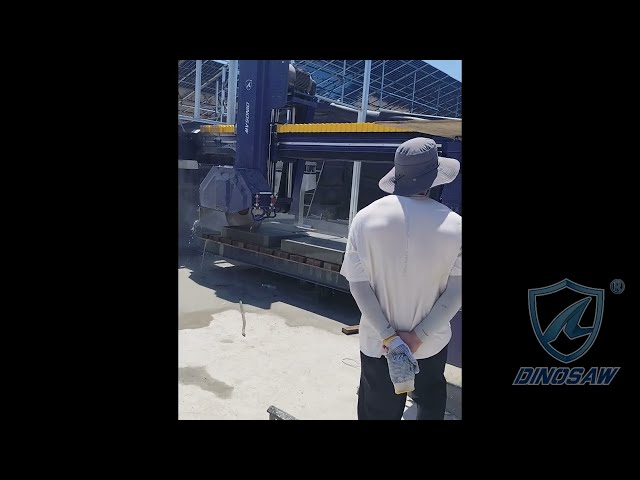
Cement board straight cutting case study using a bridge saw, focusing on edge integrity, dimensional consistency, and practical suitability for building panel production workflows.
 ▶
▶Case Snapshot
Material
Cement board
Processing Method
Bridge saw straight cutting
Typical Application
Standardized cement panels for building and prefabricated construction use
Applicable Markets
Building material processing, prefabrication workshops, construction component manufacturing
Processing Focus
Maintaining straight edges and consistent panel dimensions during batch cement board cutting
Associated Product
Bridge cutting machine
Cement boards are widely processed as flat construction panels used before installation or assembly.
In typical production settings, these boards are delivered in large formats and cut down to standardized sizes so they can be stacked, transported, and installed alongside matching components.
Unlike decorative stone products, cement boards are processed with a clear focus on usability.
Straight cuts, clean edges, and consistent dimensions matter more than surface appearance, since the panels are usually integrated into structural or concealed building systems.
This makes straight cutting one of the most common and critical operations in cement board workshops.
Workshops handling cement boards encounter several recurring challenges during straight cutting operations.
The material is dense and rigid, but it does not tolerate instability well, making edge damage a common concern.
Large panel sizes increase sensitivity to alignment and support conditions along the cutting path.
During continuous production, dust and slurry can affect visibility and handling if not kept under control.
Any inconsistency in straightness or edge condition tends to show up later during stacking, transport, or installation.
On the workshop floor, the challenge is not whether the board can be cut, but whether every board comes out the same.
Cement boards are unforgiving when something is slightly off.
If the support is uneven or the cut does not stay stable from start to finish, the edge difference becomes obvious, especially on longer panels.
Often the issue only appears later, when boards are placed side by side and no longer line up cleanly.
Bridge saw cutting is preferred because the cutting path is fixed and predictable.
For cement boards that are mostly rectangular and straight-edged, operators value a stable linear movement more than flexibility.
Once the board is positioned correctly, the cutting process follows a clear and repeatable routine, which suits batch production very well.
In practice, operators pay the most attention to how the board is seated on the table.
If the panel is not fully supported, problems tend to show up along the edge during the cut.
They also listen to the cutting process and watch the cut line closely, since irregular sounds or movement usually indicate that the board is not cutting evenly.
Quality is judged in a very practical way.
Edges should be straight, corners should be clean, and the board should be ready to stack or move to the next stage without extra trimming.
If panels can be handled and installed without corrective work, the cut is considered acceptable.
Cement boards were placed flat on the working table and aligned against fixed references to ensure consistent positioning.
The cutting operation followed a single straight path from entry to exit, prioritizing stable movement over adjustment during the cut.
After cutting, panels were visually inspected for edge condition and straightness before being stacked or transferred to the next production stage.
The overall handling approach emphasized repeatability across batches rather than individual fine tuning.
Finished cement boards showed straight, uniform edges suitable for direct use in building applications.
Panels remained consistent in size, allowing them to be stacked and handled without mismatch.
The cutting process stayed stable during repeated operations, fitting naturally into routine workshop workflows.
Results met practical expectations for construction-oriented panel production rather than decorative evaluation.
If you are handling cement boards as standardized building panels,
if your production focuses on straight cutting for construction or prefabrication use,
if edge condition and dimensional consistency are critical for downstream handling and installation,
this case reflects a typical and repeatable processing scenario found in building material workshops.
 English
Get A Easy Solution
Chat Online
Hi, this is Lizzy from Dinosaw ( Not a Robot ). Which Machine ( model ) do you want? Please WhatsApp us now
Hello 👋 How can we help?