




 中文
中文 Italian
 Türkçe
 Português
 Español
 Deutsch
 العربية
 Tiếng Việt
 Français
 Русский
 한국어
한국어


Ms.Lizzy
Hi, this is Lizzy from Dinosaw ( Not a Robot ). Which Machine ( model ) do you want? Please WhatsApp us now


Open Hours:8:30am-20:30pm

WhatsApp: +86 198-5901-3937

 Nov 11, 20255 MIN READ
 Nov 11, 20255 MIN READ
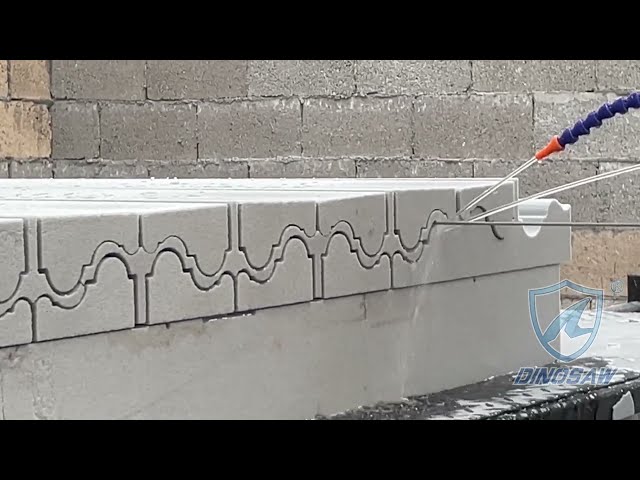
Foam ceramic window trim profile cutting case study using CNC wire saw, showing how architectural mouldings and decorative window surrounds are shaped with clean edges and consistent profiles.
 ▶
▶Material
Foam ceramic
Processing Method
CNC wire saw profile and contour cutting
Typical Application
Architectural window trims, mouldings, and decorative surrounds
Applicable Markets
Architectural decoration, prefabricated façade systems, building component fabrication
Processing Focus
Accurate profile cutting of repetitive window trim shapes with clean edges and consistent geometry
Associated Product
CNC wire saw machine for Foam Ceramic cutting
Foam ceramic window trims are commonly used as decorative and functional elements around windows, openings, and façade details.
They are often designed as repeating profiles that run continuously along building elevations, requiring consistent geometry from piece to piece.
Unlike flat panels, window trims are defined by their cross-sectional profile.
The accuracy of the profile directly affects how well pieces align during installation and how clean the finished façade appears.
As a result, profile cutting becomes a critical stage in the production of foam ceramic window surrounds.
Producing window trims from foam ceramic introduces several practical challenges in workshop conditions.
The material is lightweight and easy to cut, but it reacts quickly to unstable movement.
Profiles often include curves, steps, and recessed details that must remain sharp and consistent.
Small defects along the edge become very noticeable once trims are installed in long, continuous runs.
Consistency across batches is essential, especially when trims are produced over multiple days or production cycles.
In practice, the difficulty is not the hardness of the material, but the shape itself.
Window trims repeat the same profile over and over, so any small deviation stands out once pieces are lined up on the wall.
Foam ceramic cuts easily, but if the motion is uneven, the profile loses its definition very quickly.
Wire saw cutting allows the profile to be followed smoothly without stressing the material.
For trims with curved and stepped sections, the wire transitions naturally through the shape.
This helps keep the edges clean and the profile consistent, which is exactly what installers care about on site.
Operators focus first on how the block is supported, because movement during cutting shows up immediately in the profile.
They also watch the wire closely as it moves through corners and recesses, where defects are most likely to appear.
The goal is a steady, predictable cut rather than a fast one.
Quality is judged by how the trim pieces fit together visually.
If multiple pieces can be placed end to end and the profile lines up without gaps or uneven transitions, the cut is considered good.
When trims can go straight to installation or coating without touch-up, the result meets workshop expectations.
Foam ceramic blocks were positioned and secured to ensure stable cutting along the profile.
Predefined profile paths guided the wire saw through curved and stepped sections in a continuous motion.
The cutting process emphasized smooth progression and shape consistency rather than aggressive material removal.
After cutting, trims were visually checked for profile accuracy before being moved to finishing or installation stages.
Finished window trims showed clear, well-defined profiles with clean edges.
Pieces produced in the same run aligned consistently when placed together.
Surface condition supported downstream coating or finishing without corrective reshaping.
The cutting process integrated smoothly into routine architectural component production.
If you are producing foam ceramic window trims or architectural mouldings,
if your projects require repeated profiles with consistent geometry,
if installation quality depends on clean edges and accurate profile definition,
this case reflects a practical processing scenario commonly seen in architectural foam ceramic fabrication.
 English
Get A Easy Solution
Chat Online
Hi, this is Lizzy from Dinosaw ( Not a Robot ). Which Machine ( model ) do you want? Please WhatsApp us now
Hello 👋 How can we help?