



 中文
中文 Italian
 Türkçe
 Português
 Español
 Deutsch
 العربية
 Tiếng Việt
 Français
 Русский
 한국어
한국어


Ms.Lizzy
Hi, this is Lizzy from Dinosaw ( Not a Robot ). Which Machine ( model ) do you want? Please WhatsApp us now


Open Hours:8:30am-20:30pm

WhatsApp: +86 198-5901-3937

 Jun 25, 20245 MIN READ
 Jun 25, 20245 MIN READ
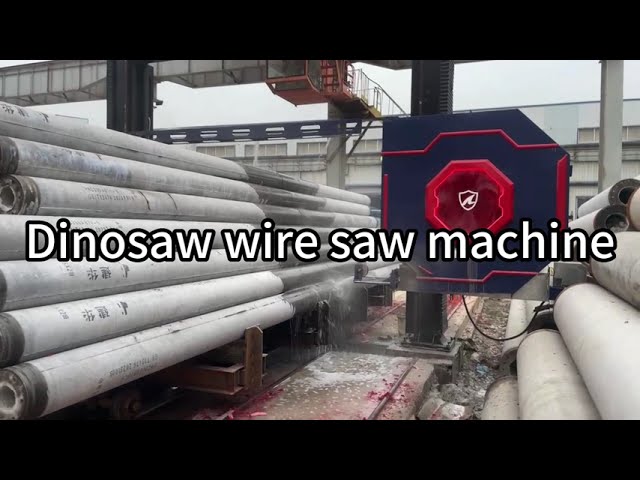
Reinforced concrete pipe cutting case study using a gantry wire saw by Dinosaw Machinery to cut extra-long pipes into uniform lengths for infrastructure applications.
 ▶
▶Case Snapshot
Material: Reinforced Concrete
Processing Method: Cutting
Typical Application: Large-diameter concrete pipe production
Applicable Markets: Infrastructure and municipal construction markets
Processing Focus: Stable length cutting of extra-long reinforced concrete pipes
Associated Product: Dinosaw Gantry Block Cutting Wire Saw Machine
This case reflects a common production scenario in reinforced concrete pipe manufacturing, where extra-long concrete pipes must be cut into standardized lengths before transportation, installation, or further assembly.
In this application, the concrete pipes are heavy and oversized, making manual handling impractical.
To support repeatable cutting operations, the pipes are placed on rail-mounted trolleys, allowing controlled forward and backward movement during the cutting process.
This type of setup is widely used in factories supplying drainage systems and municipal infrastructure projects, where consistency and handling safety are critical.
Cutting reinforced concrete pipes presents challenges beyond standard concrete or stone processing.
Workshops dealing with similar applications typically encounter issues such as:
Maintaining cutting stability over long pipe lengths
Achieving consistent segment lengths across batches
Managing steel reinforcement embedded inside the concrete
Preventing pipe movement during cutting due to weight and inertia
Coordinating cutting operations with rail-based material handling systems
These challenges become more pronounced as pipe diameter and length increase.
When dealing with reinforced concrete pipes of this length, overall stability becomes the primary concern on the production floor.
Even minor movement during cutting can affect alignment, especially when uniform segment length is required for downstream installation or stacking.
The presence of internal steel reinforcement adds another layer of complexity, as cutting conditions can change while progressing through different sections of the pipe.
In large concrete pipe production environments, gantry-type wire saw systems are commonly used because they can span oversized workpieces while maintaining a controlled cutting path.
This configuration allows the cutting system to remain stable while accommodating the full diameter and length of reinforced concrete pipes.
In this case, the gantry wire saw solution provided by Dinosaw Machinery offered sufficient working range and structural rigidity for cutting extra-long pipes in a repeatable manner.
During cutting, operators pay close attention to pipe positioning on the rail-mounted trolley.
Ensuring that the pipe is fully stabilized before cutting begins is critical, particularly when the trolley is moved forward or backward to position successive cuts.
Maintaining a smooth and continuous cutting motion is also important, especially when passing through reinforced sections of the pipe, where sudden load changes may occur.
From a production perspective, cutting quality is considered acceptable when pipe segments are cleanly separated and maintain consistent length across batches.
Equally important is the ability to handle and move the cut segments safely without requiring additional corrective work.
These criteria are commonly used in reinforced concrete pipe manufacturing to ensure compatibility with downstream handling and installation requirements.
This case is particularly relevant for:
Manufacturers producing large-diameter or extra-long reinforced concrete pipes
Infrastructure suppliers involved in drainage and municipal pipeline projects
Workshops using rail-based systems for handling oversized concrete components
Facilities evaluating gantry wire saw solutions from Dinosaw Machinery for pipe cutting applications
If you are cutting reinforced concrete pipes into standardized lengths and need a stable, repeatable approach, this case provides a practical reference.
 English
Get A Easy Solution
Chat Online
Hi, this is Lizzy from Dinosaw ( Not a Robot ). Which Machine ( model ) do you want? Please WhatsApp us now
Hello 👋 How can we help?