



 中文
中文 Italian
 Türkçe
 Português
 Español
 Deutsch
 العربية
 Tiếng Việt
 Français
 Русский
 한국어
한국어


Ms.Lizzy
Hi, this is Lizzy from Dinosaw ( Not a Robot ). Which Machine ( model ) do you want? Please WhatsApp us now


Open Hours:8:30am-20:30pm

WhatsApp: +86 198-5901-3937

 Sep 17, 20245 MIN READ
 Sep 17, 20245 MIN READ
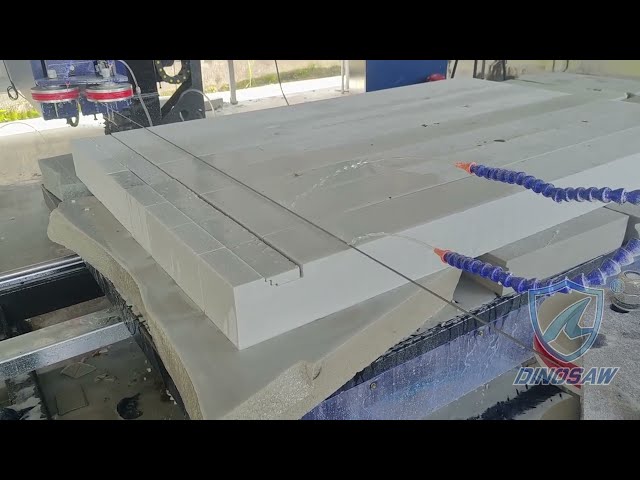
Foam ceramic balustrade cutting case study using CNC wire saw cutting, focusing on shape flexibility, edge integrity, and suitability for square and profiled balustrade production.
 ▶
▶Case Snapshot
Material
Foam ceramic
Processing Method
CNC wire saw profiling and straight cutting
Typical Application
Square and profiled foam ceramic balustrades for architectural use
Applicable Markets
Architectural components, prefabricated building materials, decorative construction elements
Processing Focus
Flexible shaping and clean edge control on lightweight foam ceramic balustrade blocks
Associated Product
DINOSAW CNC wire saw machine for foamed ceramic
Foam ceramic balustrades are commonly produced as lightweight architectural elements used in railings, terraces, stair systems, and façade details.
In many projects, these balustrades are not cylindrical but square or partially profiled, allowing for simpler installation and modular assembly.
Production usually starts from rectangular foam ceramic blocks that are cut into repeated balustrade forms before surface finishing or coating.
Because the material is lightweight and brittle, shaping accuracy and edge condition play an important role in determining whether pieces can move directly into installation-ready workflows.
Cutting foam ceramic presents a different set of challenges compared with natural stone.
The material is easy to remove but sensitive to uneven force and vibration.
Edges can chip or crumble if the cutting path is unstable.
Balustrade shapes often require multiple straight and curved transitions within a single piece.
Maintaining consistency across batches is essential when balustrades are installed side by side in visible architectural areas.
From the workshop perspective, the material itself is forgiving but fragile.
It cuts easily, but if the movement is not smooth, the edges suffer immediately.
Because balustrades are repeated elements, even small differences between pieces become noticeable once they are lined up on site.
Wire saw cutting works well because it follows the intended shape without applying concentrated force.
For square or profiled balustrades, the wire can handle straight sections and gentle curves in one continuous process.
This makes it easier to maintain uniform shapes across a batch without stressing the material.
Operators focus on keeping the block well supported and watching the wire path closely.
They pay attention to transitions where the profile changes direction, since those areas are most likely to show defects.
Smooth progression matters more than cutting speed when working with foam ceramic.
Quality is judged by how clean the edges look and whether the shape matches the intended profile.
If the balustrade can move directly to finishing or installation without patching or reshaping, the cut is considered acceptable.
Foam ceramic blocks were positioned securely to prevent movement during cutting.
Predefined cutting paths guided the wire saw through straight sections and profile transitions.
The process emphasized stable, continuous motion rather than aggressive cutting.
After cutting, balustrades were visually checked for shape consistency and edge condition before proceeding to finishing.
Finished balustrades showed consistent shapes and clean edges suitable for architectural use.
Pieces within the same batch aligned well when placed together.
Surface condition supported downstream coating or finishing without corrective work.
The cutting approach integrated smoothly into routine foam ceramic production workflows.
If you are producing foam ceramic balustrades with square or profiled geometries,
if your applications require lightweight architectural elements with consistent shapes,
if flexibility in form matters more than rotational symmetry,
this case reflects a practical processing scenario commonly seen in foam ceramic fabrication.
 English
Get A Easy Solution
Chat Online
Hi, this is Lizzy from Dinosaw ( Not a Robot ). Which Machine ( model ) do you want? Please WhatsApp us now
Hello 👋 How can we help?