




 中文
中文 Italian
 Türkçe
 Português
 Español
 Deutsch
 العربية
 Tiếng Việt
 Français
 Русский
 한국어
한국어


Ms.Lizzy
Hi, this is Lizzy from Dinosaw ( Not a Robot ). Which Machine ( model ) do you want? Please WhatsApp us now


Open Hours:8:30am-20:30pm

WhatsApp: +86 198-5901-3937

 Aug 10, 20255 MIN READ
 Aug 10, 20255 MIN READ
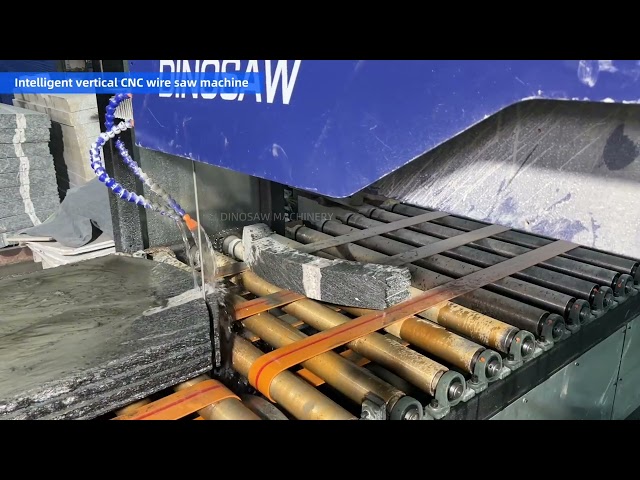
Granite curved kerbstone cutting case study using a dinosaw vertical diamond wire saw cutting machine, showing how arc-shaped kerb units are produced with consistent curvature and clean edges.
 ▶
▶Case Snapshot
Material
Granite
Processing Method
Diamond wire saw cutting
Typical Application
Curved granite kerbstones for road edges, tree surrounds, and landscape borders
Applicable Markets
Municipal stone fabrication, urban landscaping, infrastructure stone processing
Processing Focus
Accurate arc cutting with consistent radius and surface quality
Associated Product
Dinosaw Kerbstone vertical diamond wire saw cutting machine
Granite kerbstones are widely used in urban landscapes, road edges, tree surrounds, plazas, and pedestrian zones.
Curved kerbstones — those with a defined radius rather than straight sections — are necessary around roundabouts, planting bays, and design features that require a continuous curve rather than segmented straight units.
In everyday stone fabrication workflows, producing curved kerbstones with stable radius and clean cut surfaces is a blend of geometry control and material handling.
Small deviations in radius or edge condition can lead to gaps, uneven joints, or aesthetic inconsistency on site.
Curved kerbstone production introduces challenges beyond straight linear cutting.
Granite’s high hardness and abrasive mineral content demand a steady cutting motion; sudden direction changes or tool instability can cause surface irregularities.
Maintaining a consistent radius across multiple pieces is critical, because even minor variations become noticeable after assembly in continuous runs.
The curved profile also poses mechanical challenges in tool engagement and wire tension control.
From the workshop’s perspective, the challenge isn’t just the arc itself — it’s keeping that arc uniform across all pieces.
Straight sections can forgive slight variation, but when units must form a circle or smooth curve on site, any mismatch shows immediately.
Diamond wire saw cutting provides a smooth cutting action that adapts naturally to changing directions along a curve.
Rather than stepwise cutting with rotating blades, the continuous wire maintains contact all along the profile, helping to keep the arc consistent from piece to piece.
Operators focus on how the granite reacts at the beginning and end of each arc segment.
They watch wire tension and vibration feedback carefully, because these reflect whether the radius is being maintained.
Support and stable feed motion are key — if the slab shifts or the wire tension fluctuates, the arc quality suffers.
Quality is judged by fitting pieces together in a dry assembly.
When several curved kerbstones are placed end to end, the continuous line should have a uniform radius without visible kinks or gaps.
Edges should remain clean without noticeable micro-fractures, reducing the need for on-site trimming or adjustment.
Large granite blocks were positioned to support stable wire engagement along the intended curved path.
The diamond wire saw cutting machine was set up with the required arc radius and cutting sequence.
Controlled motion guided the wire through each segment of the curve, keeping tension and feed stable throughout the cut.
After cutting, kerbstones were visually checked against templates and dry-assembled to verify radius consistency before finishing.
Finished granite kerbstones showed consistent arc radius and clean cut surfaces.
Pieces aligned well when assembled in sequence, forming a smooth continuous curve.
Edge quality and surface condition met workshop standards, reducing secondary finishing time.
The cutting approach integrated well into routine municipal and landscape stone fabrication workflows.
If you are producing granite kerbstones with arc or curved geometry,
if consistent radius and edge quality matter in installation outcomes,
if minimizing adjustment time during assembly is important,
this case reflects a practical curved kerbstone cutting scenario commonly seen in urban stone fabrication.
 English
Get A Easy Solution
Chat Online
Hi, this is Lizzy from Dinosaw ( Not a Robot ). Which Machine ( model ) do you want? Please WhatsApp us now
Hello 👋 How can we help?