






 中文
中文 Italian
 Türkçe
 Português
 Español
 Deutsch
 العربية
 Tiếng Việt
 Français
 Русский
 한국어
한국어


Ms.Lizzy
Hi, this is Lizzy from Dinosaw ( Not a Robot ). Which Machine ( model ) do you want? Please WhatsApp us now


Open Hours:8:30am-20:30pm

WhatsApp: +86 198-5901-3937

 Aug 24, 20255 MIN READ
 Aug 24, 20255 MIN READ
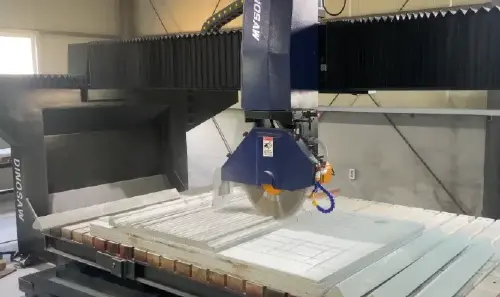
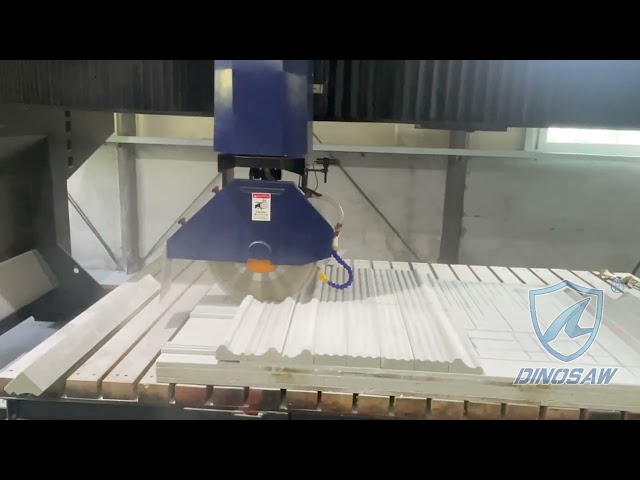
Foam ceramic decorative moulding cutting case study using CNC bridge saw, showing clean profile shaping for architectural trims and linear decorative elements.
 ▶
▶Case Snapshot
Material
Foam ceramic
Processing Method
CNC bridge saw profile and linear cutting
Typical Application
Foam ceramic decorative mouldings, trims, and architectural linear elements
Applicable Markets
Architectural decoration, façade systems, prefabricated decorative components
Processing Focus
Accurate linear cutting and profile definition for foam ceramic decorative elements
Associated Product
DINOSAW CNC mono-block bridge cutting machine
Foam ceramic decorative mouldings are widely used in architectural projects as cornices, window trims, façade lines, and other linear decorative elements.
These components are often installed in continuous sequences, where alignment, profile consistency, and edge quality directly affect the final visual result.
Unlike flat panels, decorative mouldings rely on defined cross-section profiles.
Any deviation during cutting becomes visible once multiple pieces are installed together, making precision cutting a critical step in foam ceramic moulding production.
Cutting foam ceramic decorative mouldings presents specific workshop challenges.
The material is lightweight but brittle along sharp profile edges.
Decorative lines often include repeating curves, grooves, or stepped profiles.
Maintaining straightness over long lengths is essential for installation alignment.
Surface chipping or profile distortion can compromise the decorative effect.
From the workshop perspective, mouldings are judged by their profile, not their size.
With flat panels, minor edge defects can sometimes be hidden.
With decorative lines, every edge and curve is exposed once installed, so profile accuracy becomes the main concern.
A CNC bridge saw provides stable linear movement and controlled cutting depth.
This is important for maintaining consistent cross-section profiles along the full length of each moulding.
For foam ceramic, a stable cutting path helps preserve clean edges without tearing the material.
Operators focus on material support and alignment before cutting begins.
They pay close attention to how the blade enters and exits the profile, since those points are most prone to chipping.
Consistency from one piece to the next is always a priority.
Quality is judged by profile clarity, straightness, and edge condition.
If multiple mouldings can be placed end to end with continuous lines and no visible mismatch, the cut is considered acceptable for architectural use.
Foam ceramic blocks were positioned and secured to ensure straight cutting alignment.
Predefined cutting paths guided the bridge saw along the required moulding profiles.
The cutting process emphasized smooth blade movement and controlled feed along linear paths.
Finished mouldings were visually checked for profile consistency before packaging or installation.
Decorative mouldings showed clean and well-defined profiles.
Edges remained intact along the full length of each piece.
Multiple mouldings aligned consistently when arranged in sequence.
The cutting process fit smoothly into routine decorative component production.
If you are producing foam ceramic decorative mouldings or architectural trims,
if your projects require long, continuous decorative lines with consistent profiles,
if installation quality depends on accurate cutting and clean edges,
this case reflects a practical cutting scenario commonly seen in architectural decoration workshops.
 English
Get A Easy Solution
Chat Online
Hi, this is Lizzy from Dinosaw ( Not a Robot ). Which Machine ( model ) do you want? Please WhatsApp us now
Hello 👋 How can we help?