




 中文
中文 Italian
 Türkçe
 Português
 Español
 Deutsch
 العربية
 Tiếng Việt
 Français
 Русский
 한국어
한국어


Ms.Lizzy
Hi, this is Lizzy from Dinosaw ( Not a Robot ). Which Machine ( model ) do you want? Please WhatsApp us now


Open Hours:8:30am-20:30pm

WhatsApp: +86 198-5901-3937

 Feb 17, 20255 MIN READ
 Feb 17, 20255 MIN READ
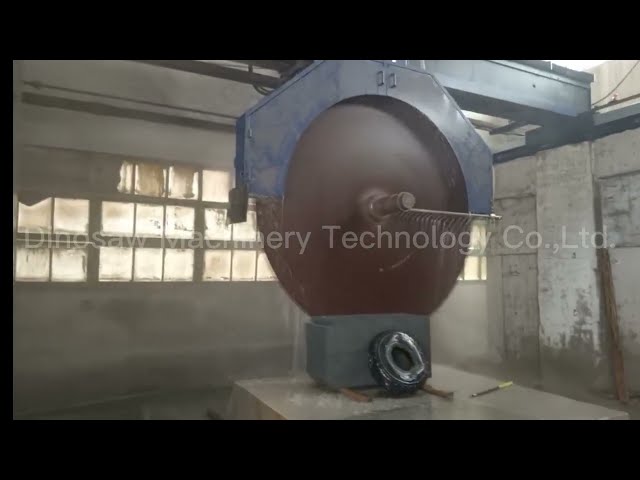
Granite block cutting case study using industrial stone block cutting machine, showing how raw granite blocks are cut into slab blanks with stable dimensional accuracy and material yield.
 ▶
▶Material
Raw granite block
Processing Method
Industrial block cutting
Typical Application
Cutting granite blocks into slab blanks for flooring, countertops, wall cladding, and architectural panels
Applicable Markets
Stone fabrication, slab production, architectural stone supply
Processing Focus
Consistent dimensional control and optimized yield from large granite blocks
Associated Product
Dinosaw Multi-blade Stone block cutting machine
In stone fabrication workflows, the first and most fundamental operation on raw stone is block cutting.
Large granite blocks delivered to workshops must be cut down into workable slabs and blanks before further surface processing, profiling, polishing, or edge finishing.
The quality of this initial cut sets the foundation for all subsequent operations.
Accurate dimensional control ensures slabs fit into predefined size requirements for architectural projects, while maximizing usable surface area improves overall material yield.
Cutting raw granite blocks presents a set of practical challenges that differ from finishing or profiling operations.
Granite’s high hardness and abrasive mineral composition place demands on cut stability.
Blocks are often uneven in geometry and density, making stable support and precision feed necessary to avoid deviation.
Incorrect cutting path or unstable tool behavior can cause slab thickness variation, surface marks, or material waste.
From the workshop point of view, this is where the material speaks first.
Granite blocks are not uniform; they vary in density, microstructure, and size.
If the cutting movement is not stable, even slight deviation shows up as thickness variation or surface marking on the slab.
Industrial machines provide the rigidity and controlled feed necessary for granite.
They maintain stable tool engagement over the block’s full length and depth.
For granite, this controlled movement is what prevents edge chipping and keeps dimensional accuracy consistent from slab to slab.
Operators focus on support and alignment before cutting starts.
Ensuring the stone is stable and the feed path is correct helps the machine follow the intended cut without deviation.
During cutting, they observe vibration and cutting resistance; any abnormal behavior signals the need to reassess setup conditions.
Quality is judged by dimensional uniformity and how well the resulting slab blanks fit subsequent processing requirements.
If slabs come off with consistent thickness and clean cut faces, they are considered ready for flattening, polishing, and profiling.
Minimal material waste and reduced need for rework are also practical measures used on the floor.
Granite blocks were placed and secured to prevent movement during cutting.
The industrial cutting machine was configured with appropriate feed settings and blade selection for granite hardness.
Cutting was performed along predefined paths to produce slab blanks with consistent dimensions.
After cutting, slabs were inspected visually and dimensionally before being moved to downstream operations such as flattening and polishing.
Finished slab blanks showed consistent thickness and clean cut faces suitable for further processing.
Material yield was improved by minimizing kerf loss and reducing the need for corrective grinding.
Slabs aligned well with project size requirements, simplifying downstream planning.
The cutting process proved stable across multiple blocks with varying physical characteristics.
If you are cutting raw granite blocks into slab blanks,
if consistent dimensional accuracy affects your downstream processing flow,
if maximizing yield from stone blocks matters in your production,
this case reflects a practical cutting scenario commonly seen in stone fabrication workshops.
 English
Get A Easy Solution
Chat Online
Hi, this is Lizzy from Dinosaw ( Not a Robot ). Which Machine ( model ) do you want? Please WhatsApp us now
Hello 👋 How can we help?