




 中文
中文 Italian
 Türkçe
 Português
 Español
 Deutsch
 العربية
 Tiếng Việt
 Français
 Русский
 한국어
한국어


Ms.Lizzy
Hi, this is Lizzy from Dinosaw ( Not a Robot ). Which Machine ( model ) do you want? Please WhatsApp us now


Open Hours:8:30am-20:30pm

WhatsApp: +86 198-5901-3937

 Mar 20, 20245 MIN READ
 Mar 20, 20245 MIN READ
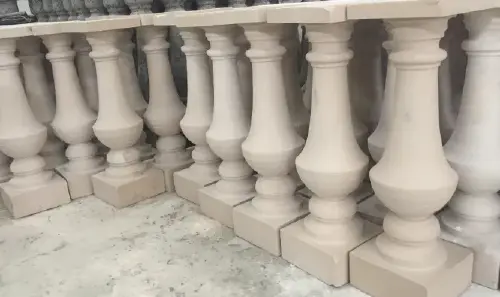
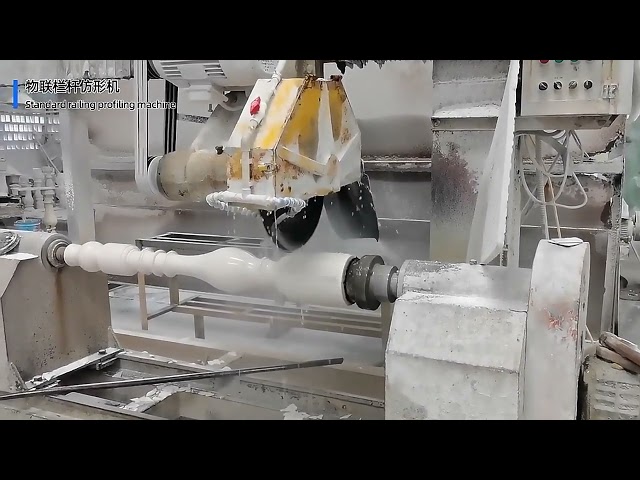
Marble baluster machining case study using a CNC stone lathe, showing consistent shaping of architectural railing components for stair and balcony applications.
 ▶
▶Case Snapshot
Material
Marble
Processing Method
CNC stone turning and profile shaping
Typical Application
Marble balusters and stone railing components
Applicable Markets
Architectural stone fabrication, staircase and balcony railing production
Processing Focus
Repeatable profile accuracy and visual consistency across baluster batches
Associated Product
Dinosaw CNC Stone Lathe
Marble balusters are widely used in staircases, balconies, and architectural railings, where both structural reliability and visual uniformity are required.
Unlike flat stone panels, balusters are three-dimensional components that must maintain the same profile and proportions from piece to piece.
In real fabrication environments, balusters are rarely produced as one-off items.
They are manufactured in batches, and once installed side by side, even small deviations in shape or proportion become immediately visible.
This makes profile repeatability a primary concern in marble baluster production.
Marble baluster machining introduces challenges that differ from slab cutting or surface polishing.
The material’s internal grain structure can change cutting resistance along the profile.
If tool movement is unstable, surface stepping or profile distortion may appear.
Length consistency, symmetry, and smooth transitions between profile sections are all critical for proper alignment during installation.
Manual shaping or semi-automatic methods often lead to variation between pieces, increasing downstream finishing time and on-site adjustment.
From the workshop point of view, the challenge is not complexity but repetition.
A single baluster can look fine, but once you place ten or twenty together, small differences stand out.
Maintaining the same diameter, curve depth, and transition shape across the whole batch is what really tests the process.
A CNC stone lathe allows the profile to be defined once and repeated consistently.
Instead of relying on operator judgment for each piece, the machine follows the same programmed path every time.
For marble balusters, this consistency is more important than cutting speed or decorative complexity.
Operators focus on material support and cutting stability.
They watch how the tool moves through curved sections and transitions, where marble is most sensitive to vibration.
Stable motion through these areas is key to achieving clean, even surfaces before polishing.
Quality is judged by direct comparison.
Balusters are placed side by side to check profile alignment and symmetry.
If pieces match visually and require minimal touch-up before finishing, the machining is considered acceptable.
Marble blanks were positioned securely on the CNC stone lathe to prevent movement during turning.
The baluster profile was programmed according to the required architectural design.
Machining proceeded in controlled passes to shape the marble accurately while maintaining surface integrity.
After machining, balusters were inspected for profile consistency before moving to polishing or surface finishing.
Machined marble balusters showed consistent cross-section profiles across multiple pieces.
Surface transitions remained smooth and uniform along the full length.
Batch-to-batch variation was reduced, simplifying finishing and installation.
The process supported stable, repeatable production of architectural stone components.
If you are producing marble balusters or stone railing components,
if your projects require visual consistency across repeated architectural elements,
if manual shaping leads to variation and rework,
this case reflects a practical CNC stone lathe application commonly used in professional stone workshops.
 English
Get A Easy Solution
Chat Online
Hi, this is Lizzy from Dinosaw ( Not a Robot ). Which Machine ( model ) do you want? Please WhatsApp us now
Hello 👋 How can we help?