




 中文
中文 Italian
 Türkçe
 Português
 Español
 Deutsch
 العربية
 Tiếng Việt
 Français
 Русский
 한국어
한국어


Ms.Lizzy
Hi, this is Lizzy from Dinosaw ( Not a Robot ). Which Machine ( model ) do you want? Please WhatsApp us now


Open Hours:8:30am-20:30pm

WhatsApp: +86 198-5901-3937

 May 11, 20255 MIN READ
 May 11, 20255 MIN READ
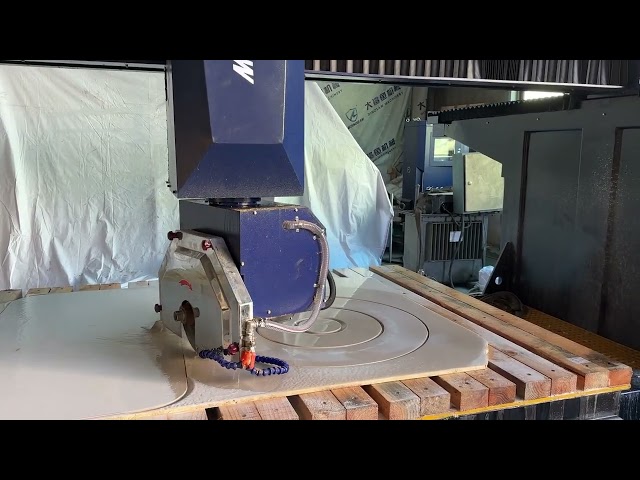
Marble countertop cutting case study using a CNC 5-Axis Bridge Saw, covering precise panel cutting, sink cutouts, and edge shaping for kitchen and interior applications.
 ▶
▶Case Snapshot
Material
Marble
Processing Method
CNC 5-Axis bridge saw cutting
Typical Application
Marble countertop panels with sink openings and finished edges
Applicable Markets
Countertop fabrication, interior stonework, kitchen and bathroom projects
Processing Focus
Accurate panel sizing, clean cutouts, and consistent edge definition
Associated Product
Dinosaw CNC 5-Axis Bridge Saw
Marble countertops are widely used in kitchens, bathrooms, and interior architectural projects where visual quality and surface continuity are critical.
Unlike flooring or wall panels, countertop slabs require precise dimensional control, integrated cutouts, and clean edge treatment to ensure proper installation and finish.
In real fabrication workflows, countertop panels are often processed in batches for the same project.
Consistency between panels matters as much as the quality of each individual piece, especially when seams, joints, or integrated features are involved.
Cutting marble countertops involves more than straight panel sizing.
Sink openings, faucet holes, and edge profiles introduce multiple transitions within a single slab.
Marble’s natural veining can change cutting resistance locally, making edge chipping or uneven transitions a risk if tool movement is unstable.
Another challenge is alignment.
Even small deviations in cutout position or edge geometry can lead to fitting issues during installation, increasing on-site adjustments and rework.
From the workshop’s point of view, countertops are judged by fit before anything else.
A slab may look good on the table, but if the sink opening is off or the edge isn’t straight, it causes problems on site.
Marble shows mistakes clearly, especially around cutouts and corners.
A CNC 5-Axis Bridge Saw allows complex cuts to be completed in a single setup.
Cutting angles, curves, and openings can be handled without repositioning the slab manually.
For marble countertops, this reduces handling errors and helps keep cutouts and edges aligned with the design.
Operators focus on slab fixation and cutting transitions.
They closely watch how the tool enters and exits cutouts, since those areas are most sensitive to chipping.
Smooth motion through corners and edges is essential to maintain surface quality before polishing.
Quality is judged by fit and finish.
Cutouts must align with sinks and fixtures, edges should be clean and straight, and panels should join without visible mismatch.
If a countertop can move directly to polishing and installation preparation without corrective cutting, the result is considered acceptable.
Marble slabs were positioned and securely fixed on the machine table.
The CNC 5-Axis Bridge Saw was programmed with panel dimensions, cutout shapes, and edge paths.
Cutting was performed with controlled multi-axis movement to maintain accuracy across straight cuts and complex features.
After cutting, panels were inspected visually and dimensionally before entering polishing and finishing stages.
Finished marble countertop panels showed accurate dimensions and clean cutouts.
Edges and corners were consistent across panels from the same batch.
Panels fit together well during dry assembly, reducing installation adjustments.
The cutting workflow supported stable and repeatable countertop production.
If you are producing marble countertops with integrated cutouts and edge profiles,
if installation accuracy and panel consistency affect project delivery,
if manual repositioning leads to fitting issues or rework,
this case reflects a practical marble countertop cutting scenario commonly seen in stone fabrication workshops.
 English
Get A Easy Solution
Chat Online
Hi, this is Lizzy from Dinosaw ( Not a Robot ). Which Machine ( model ) do you want? Please WhatsApp us now
Hello 👋 How can we help?