





 中文
中文 Italian
 Türkçe
 Português
 Español
 Deutsch
 العربية
 Tiếng Việt
 Français
 Русский
 한국어
한국어


Ms.Lizzy
Hi, this is Lizzy from Dinosaw ( Not a Robot ). Which Machine ( model ) do you want? Please WhatsApp us now


Open Hours:8:30am-20:30pm

WhatsApp: +86 198-5901-3937

 Feb 23, 20255 MIN READ
 Feb 23, 20255 MIN READ
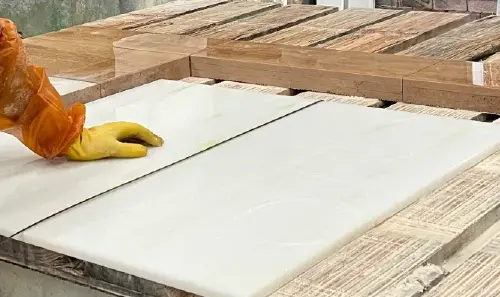
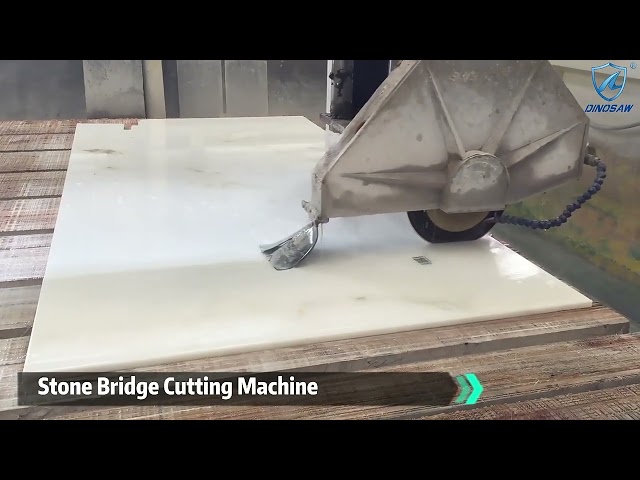
Quartz countertop panel cutting case study using a CNC stone bridge saw, showing precise slab profiling and cutout accuracy for interior stone applications.
 ▶
▶Case Snapshot
Material
Quartz slab
Processing Method
CNC stone bridge saw cutting
Typical Application
Quartz slabs for countertops, wall panels, and interior stone surfaces
Applicable Markets
Stone fabrication, countertop manufacturing, interior architectural stonework
Processing Focus
Accurate slab cutting, straight edges, and cutouts for installation fit
Associated Product
Dinosaw CNC Stone Laser Bridge Saw
Quartz slabs are widely used in countertop fabrication, interior cladding, and decorative stone applications.
As an engineered surface material with consistent hardness and structure, quartz requires precise cutting to ensure panels fit cleanly into design layouts, especially when cutouts, edges, and joint surfaces are involved.
Unlike natural stone, quartz slabs have uniform properties throughout, which supports stable cutting performance but also demands consistent motion and accurate dimension control for quality results.
In daily production, cutting quartz slabs introduces several challenges:
Panels vary in size and thickness depending on design requirements.
Cutouts for sinks, faucets, and fixtures must align precisely with installation tolerances.
Edge conditions and straightness directly affect assembly fit and visual continuity.
Slab handling and repositioning increase the potential for dimension variation.
Without controlled machining, these practical factors can lead to misalignment, uneven edges, or rework during downstream finishing and installation.
Operators often emphasize thataccuracy matters more than speed.
Quartz doesn’t vary like natural stone, but even small deviations in edge straightness or cutout placement become visible once installed.
Once you produce one panel slightly off spec, it often leads to onsite adjustment or re-cutting.
A CNC stone bridge saw provides controlled linear motion and repeatable cutting paths.
It allows operators to define exact profiles, straight cuts, and cutout positions in the program, and then execute them without manual repositioning.
For quartz slab work, this reduces fitting risk and increases consistency across panels.
Operators focus on slab support and machine feed stability.
Quartz panels sit flat, but if they move even slightly during cutting, the edge or cutout can shift out of tolerance.
Consistent feed and reliable fixture support make the process predictable from panel to panel.
On the floor, quality is judged by how panels fit together in a dry assembly.
Cutouts must match sink and fixture templates, edges must be straight, and adjacent panel surfaces should align without visible mismatch.
If panels can go directly to polishing or installation without corrective cuts, the process is successful.
Quartz slabs were loaded and secured to ensure stable contact with the machine table.
The CNC stone bridge saw was programmed with slab dimensions, feature cutouts, and edge paths defined.
Cutting proceeded with controlled motion to maintain accuracy across all features.
After cutting, slabs were inspected visually and with templates before moving to polishing and finishing.
Finished quartz panels exhibited accurate cutouts and straight edges.
Panels aligned well in dry assembly, minimizing onsite adjustments.
Dimension variation was reduced across multiple panels from the same batch.
Edges and transitions were ready for subsequent polishing and installation workflows.
If you are producing quartz slab panels for countertops, interior cladding, or decorative stone surfaces,
if fixture cutout accuracy and edge continuity matter in downstream installation,
if repeatability and process stability reduce finishing time and field rework,
this case reflects a practical quartz slab cutting scenario commonly seen in stone fabrication workshops.
 English
Get A Easy Solution
Chat Online
Hi, this is Lizzy from Dinosaw ( Not a Robot ). Which Machine ( model ) do you want? Please WhatsApp us now
Hello 👋 How can we help?