




 中文
中文 Italian
 Türkçe
 Português
 Español
 Deutsch
 العربية
 Tiếng Việt
 Français
 Русский
 한국어
한국어


Ms.Lizzy
Hi, this is Lizzy from Dinosaw ( Not a Robot ). Which Machine ( model ) do you want? Please WhatsApp us now


Open Hours:8:30am-20:30pm

WhatsApp: +86 198-5901-3937

 Sep 17, 20255 MIN READ
 Sep 17, 20255 MIN READ
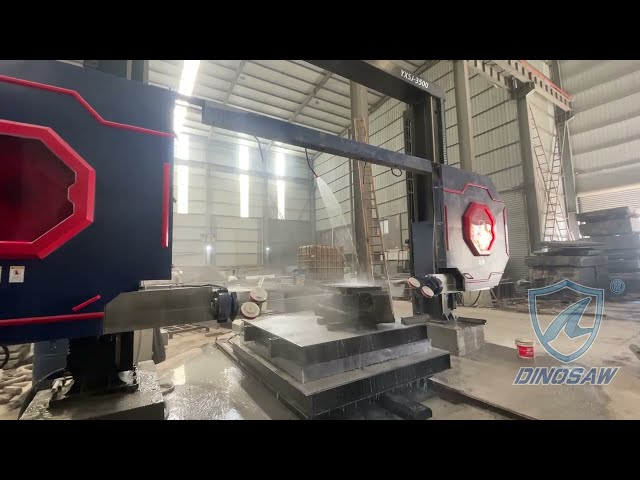
Granite curved panel cutting case study using a CNC wire saw by Dinosaw Machinery, focusing on arc accuracy, surface consistency, and stable processing for architectural applications.
 ▶
▶Case Snapshot
Material: Granite
Processing Method: Cutting
Typical Application: Curved granite panels for architectural decoration
Applicable Markets: Architectural stone fabrication and premium construction projects
Processing Focus: Arc accuracy and surface consistency on curved granite panels
Associated Product: Dinosaw CNC Wire Saw Machine
Curved granite panels are commonly used in architectural projects where natural stone is integrated into rounded façades, columns, and decorative wall elements.
Unlike flat stone slabs, curved panels require controlled shaping to achieve consistent curvature while maintaining surface quality.
In production environments, fabricators are often required to process multiple panels with identical curvature to ensure alignment during installation, making repeatability a key requirement in curved granite applications.
Processing curved granite panels introduces challenges beyond standard straight cutting.
Workshops handling similar applications typically face issues such as:
Maintaining consistent curvature across multiple panels
Controlling cutting accuracy along long arc paths
Preventing surface damage or uneven edges during curved cutting
Managing cutting stability on hard, dense granite material
Ensuring repeatability for panels used in the same installation area
These challenges make curved granite cutting more sensitive to process control than conventional slab processing.
Curved cutting requires the cutting path to follow a continuous arc rather than a straight line.
In hard materials like granite, even small deviations can affect the final curvature, especially when multiple panels need to match the same radius.
Maintaining a smooth cutting path is essential to avoid visible inconsistencies along the curved edge.
Wire saw cutting is well suited for curved panel production because it allows flexible path control along arc geometries.
Unlike rigid blade-based cutting methods, the wire saw can follow complex curves with smoother transitions, reducing localized stress on the granite.
In this application, the CNC wire saw solution provided by Dinosaw Machinery supported controlled arc cutting while maintaining surface consistency.
Operators pay close attention to path accuracy and cutting stability throughout the arc.
Ensuring consistent cutting conditions along the entire curved path is critical, particularly when working with thick granite panels.
Proper material positioning and secure support are also essential to prevent vibration or movement during cutting.
From a production perspective, curved granite panels are considered acceptable when their curvature matches design specifications and edges remain clean and uniform.
Panels must also align correctly with adjacent pieces during dry fitting, without requiring excessive corrective work.
These criteria are commonly used in architectural stone fabrication to ensure both visual quality and installation efficiency.
In this case, granite slabs were positioned and cut following predefined curved paths.
The cutting process emphasized stable movement along the arc to avoid sudden changes in cutting load that could affect surface quality.
The CNC wire saw system from Dinosaw allowed consistent execution of curved cuts across multiple panels, supporting repeatable production for architectural applications.
Based on the observed cutting process:
Curved granite panels were produced with consistent arc geometry
Edge conditions remained smooth and uniform
Panels were suitable for downstream finishing and installation
Cutting stability was maintained across multiple curved panels
These outcomes meet typical production expectations for curved granite architectural elements.
This case is particularly relevant for:
Stone fabricators producing curved granite panels for architectural projects
Workshops handling façade elements, columns, or rounded stone features
Manufacturers requiring repeatable curved cutting on hard stone materials
Facilities evaluating CNC wire saw solutions from Dinosaw Machinery for curved stone processing
If you are processing granite panels with curved geometries and require consistent arc accuracy, this case provides a practical reference scenario.
 English
Get A Easy Solution
Chat Online
Hi, this is Lizzy from Dinosaw ( Not a Robot ). Which Machine ( model ) do you want? Please WhatsApp us now
Hello 👋 How can we help?