


 中文
中文 Italian
 Türkçe
 Português
 Español
 Deutsch
 العربية
 Tiếng Việt
 Français
 Русский
 한국어
한국어


Ms.Lizzy
Hi, this is Lizzy from Dinosaw ( Not a Robot ). Which Machine ( model ) do you want? Please WhatsApp us now


Open Hours:8:30am-20:30pm

WhatsApp: +86 198-5901-3937

 Sep 12, 20255 MIN READ
 Sep 12, 20255 MIN READ
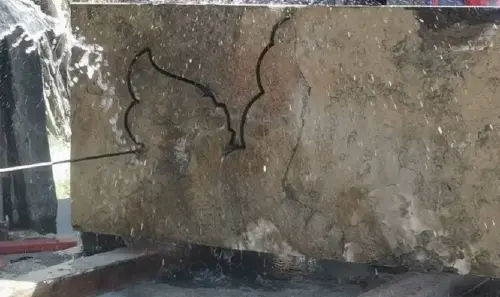
Granite monument shaping case study using CNC wire saw cutting, focusing on profile accuracy, surface continuity, and practical suitability for customized tombstone production.
 ▶
▶Case Snapshot
Material
Granite
Processing Method
CNC wire saw profiling and contour cutting
Typical Application
Customized granite tombstones and memorial monuments
Applicable Markets
Monument fabrication, stone carving workshops, memorial product manufacturing
Processing Focus
Controlled cutting of curved and irregular granite profiles for monument shaping
Associated Product
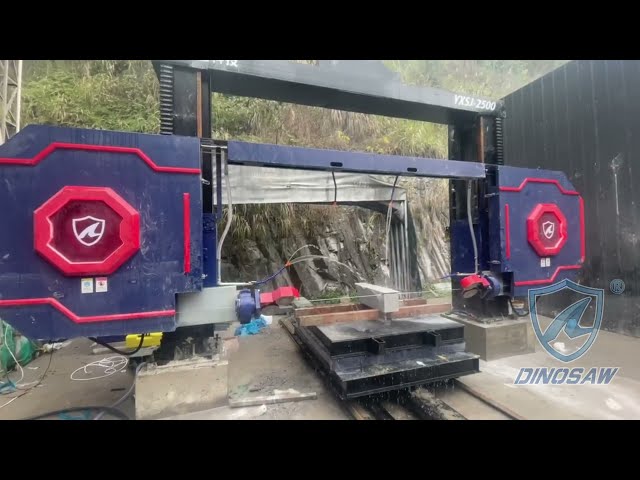
CNC wire saw tombstone cutting machine by Dinosaw Machinery
Granite tombstones and memorial monuments are commonly produced as customized pieces rather than standardized slabs.
Workshops handling this type of production often deal with varied profiles, curved outlines, and non-uniform geometries that must be shaped accurately before engraving and surface finishing.
Unlike flat architectural panels, monument products require the cut shape itself to define the final form.
Any deviation in contour or inconsistency between matching pieces becomes immediately visible once the monument is assembled or installed.
This makes profile control and surface continuity critical considerations during the cutting stage.
Processing granite monuments introduces challenges beyond straight or planar cutting.
Granite is dense and hard, which increases sensitivity to cutting stability along changing paths.
Curved and irregular profiles require smooth transitions without sudden changes in direction.
Uneven cutting behavior can leave visible marks that remain even after polishing.
Maintaining consistency across multiple monuments or matching components adds further complexity in daily production.
Operators point out that the difficulty lies in the changing geometry.
Straight cuts are predictable, but monument profiles constantly change direction.
In granite, any instability along those curves shows up immediately as uneven surfaces or slight shape distortion that cannot be corrected later.
Wire saw cutting allows the cutting path to follow the intended shape smoothly.
Unlike rigid blade-based methods, the wire adapts better to continuous curves and complex outlines.
This makes it easier to maintain a consistent profile when producing customized monument shapes.
The main focus is on keeping the cut steady throughout the entire contour.
Operators watch how the wire enters and exits curved sections and ensure the granite remains well supported.
Any vibration or irregular movement is treated as a warning sign that the final shape may not be clean.
Quality is judged by how well the cut shape matches the intended outline and how smooth the surface appears along the curve.
If the monument can proceed directly to engraving or finishing without corrective reshaping, the cut is considered acceptable.
Granite blocks were positioned and secured to support stable cutting along irregular paths.
Predefined contours guided the wire saw through continuous curves without interruption.
The cutting process emphasized smooth progression rather than speed, especially at transitions between straight and curved sections.
After cutting, shaped monuments were visually checked for profile accuracy and surface continuity before moving to the next production stage.
Finished granite monuments showed consistent contours and clean profile transitions.
Surface continuity along curved sections supported downstream engraving and polishing work.
Multiple pieces produced under the same cutting approach remained visually consistent.
The cutting process integrated smoothly into routine monument production workflows.
If you are handling customized granite tombstones or memorial monuments,
if your production involves curved or irregular stone profiles rather than straight cuts,
if profile accuracy and surface continuity affect downstream carving and finishing,
this case reflects a common and practical processing scenario in monument fabrication workshops.
 English
Get A Easy Solution
Chat Online
Hi, this is Lizzy from Dinosaw ( Not a Robot ). Which Machine ( model ) do you want? Please WhatsApp us now
Hello 👋 How can we help?