




 中文
中文 Italian
 Türkçe
 Português
 Español
 Deutsch
 العربية
 Tiếng Việt
 Français
 Русский
 한국어
한국어


Ms.Lizzy
Hi, this is Lizzy from Dinosaw ( Not a Robot ). Which Machine ( model ) do you want? Please WhatsApp us now


Open Hours:8:30am-20:30pm

WhatsApp: +86 198-5901-3937

 Oct 9, 20255 MIN READ
 Oct 9, 20255 MIN READ
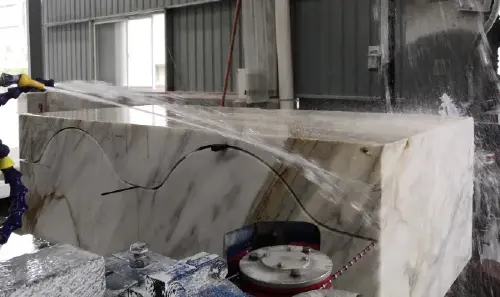
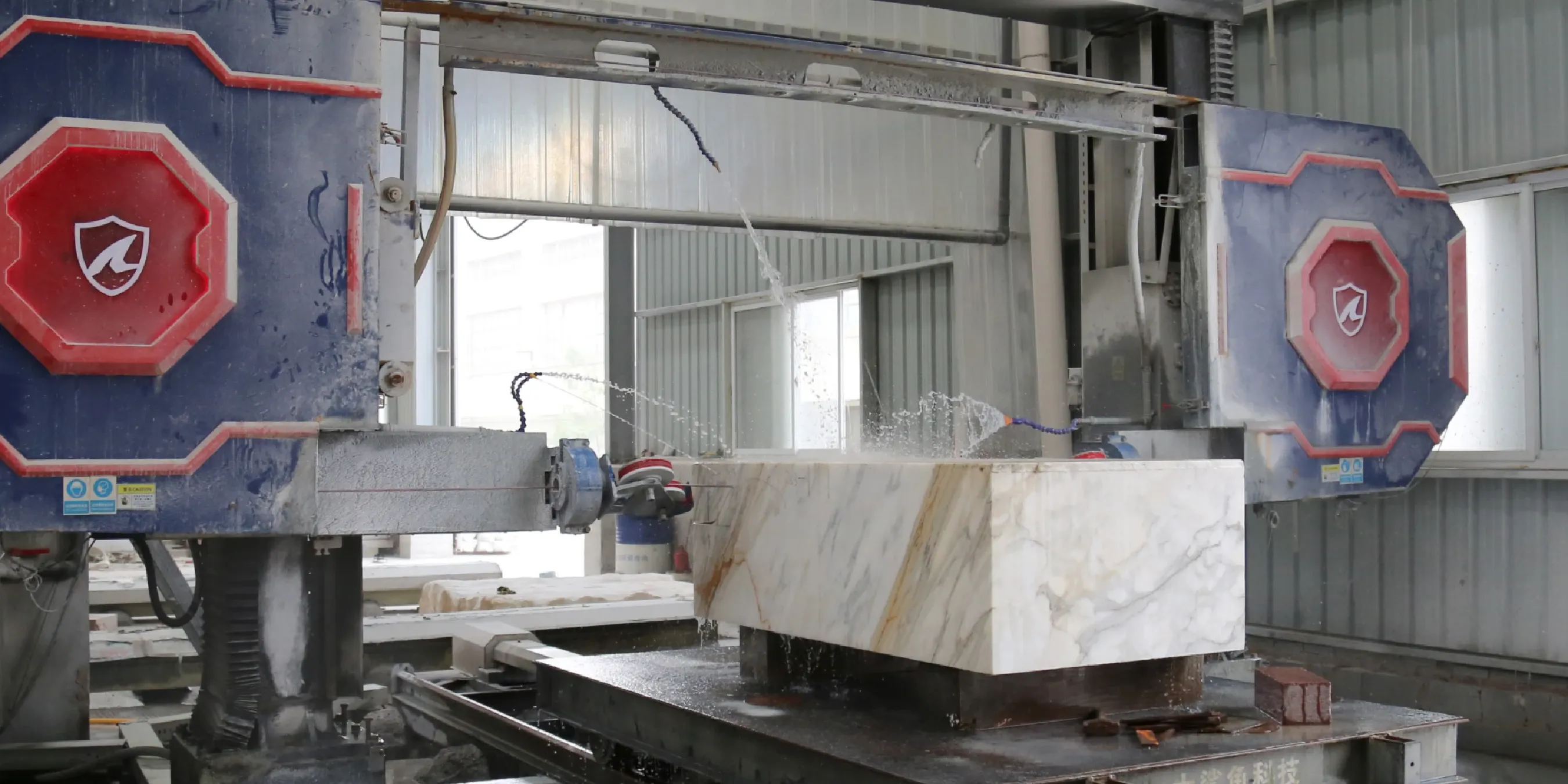
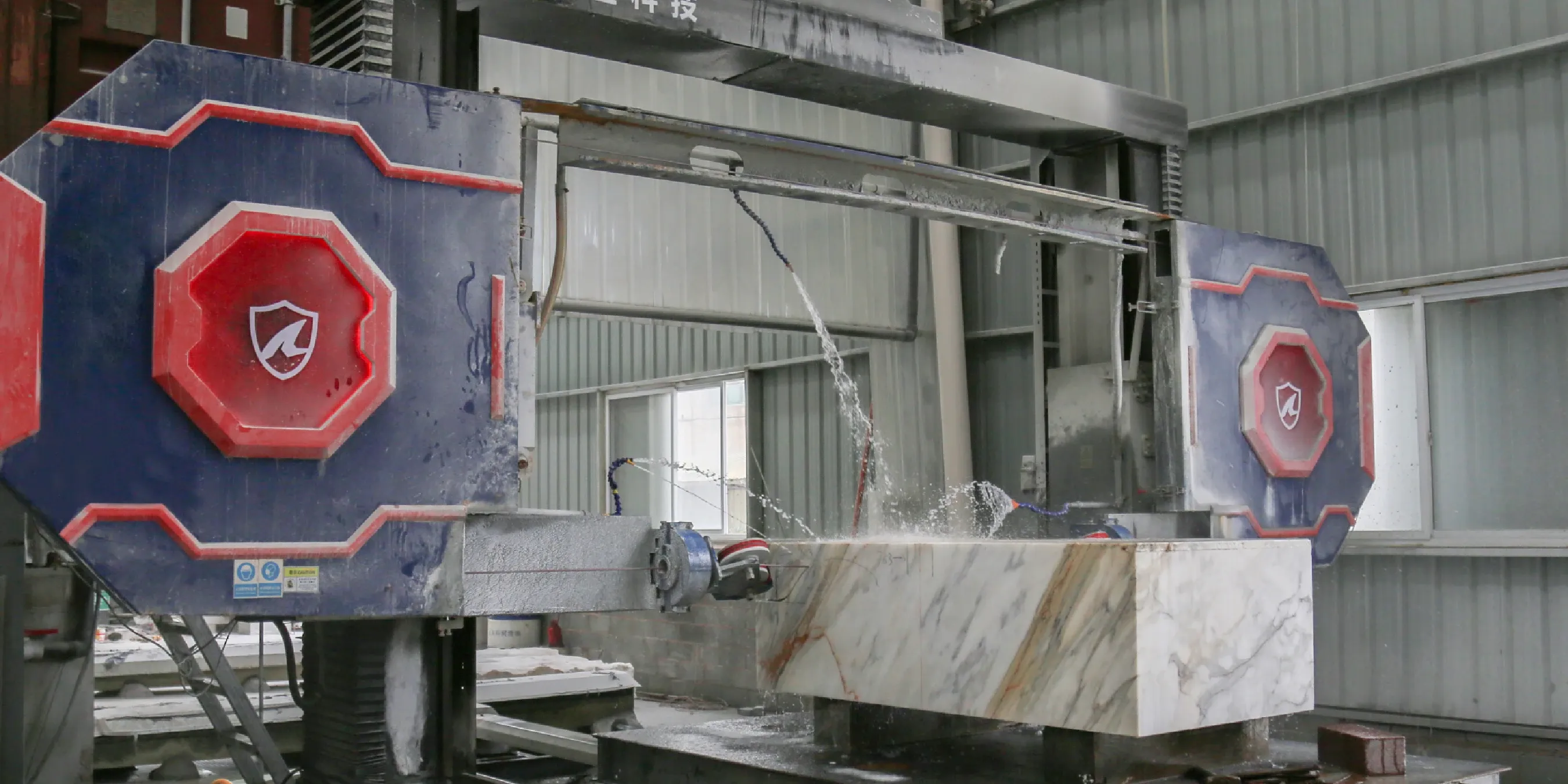
Marble reception counter cutting case using a CNC wire saw machine, focusing on large-format curved profiles for hotel and commercial interior front desks.
Case Snapshot
Material
Marble
Processing Method
CNC wire saw cutting
Typical Application
Large reception counters, bar counters, and custom interior stone features
Applicable Markets
Commercial interiors, hospitality projects, custom stone fabrication
Processing Focus
Continuous curved profiles on large stone blocks with controlled material removal
Associated Product
Dinosaw CNC Diamond Wire Saw Cutting Machine
Large marble reception counters and bar counters are commonly produced as one-piece or segmented blocks to achieve a seamless visual effect.
These elements are often used in hotel lobbies, commercial front desks, clubs, and high-end interior spaces where straight-line geometry is not sufficient.
In this type of production, the stone is typically supplied as a thick marble block, and the overall counter shape—including long curves and varying radii—must be formed before secondary finishing and surface polishing.
Cutting large-format marble counters introduces several workshop-level challenges:
Long, continuous curves require stable cutting without stopping points
Large block size increases sensitivity to vibration and deflection
Visual surfaces must remain intact for later finishing stages
Shape accuracy must be consistent across the entire counter length
Traditional blade-based cutting methods often struggle to maintain smooth transitions on thick blocks when complex curves are involved.
Operators note that the main difficulty comes from the combination of size and shape.
The block is heavy and rigid, while the design demands smooth curves rather than straight cuts.
Any hesitation or uneven movement during cutting can be visible later on the finished front-facing surface.
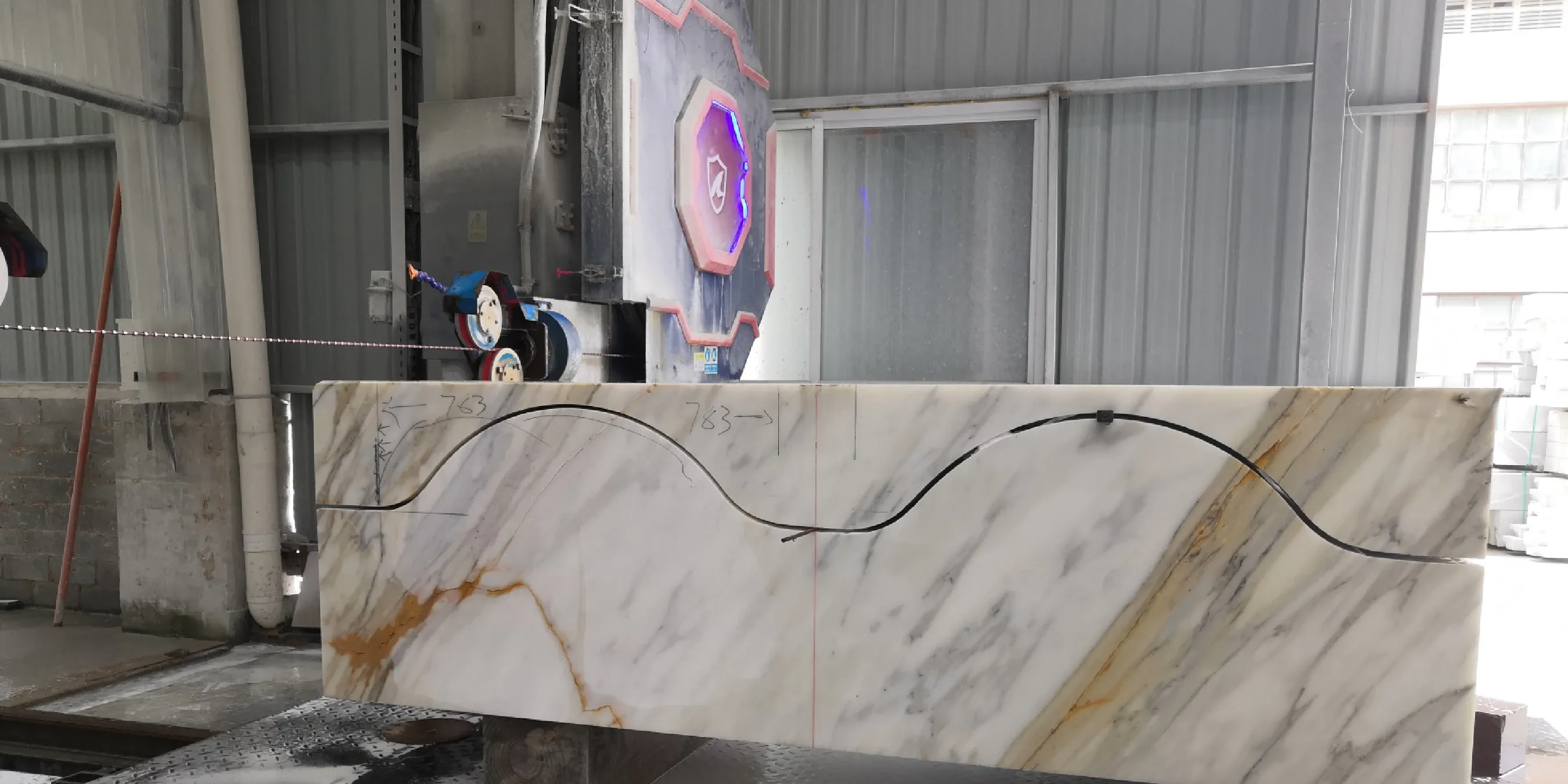
Wire saw cutting allows the curve to be followed as a continuous path.
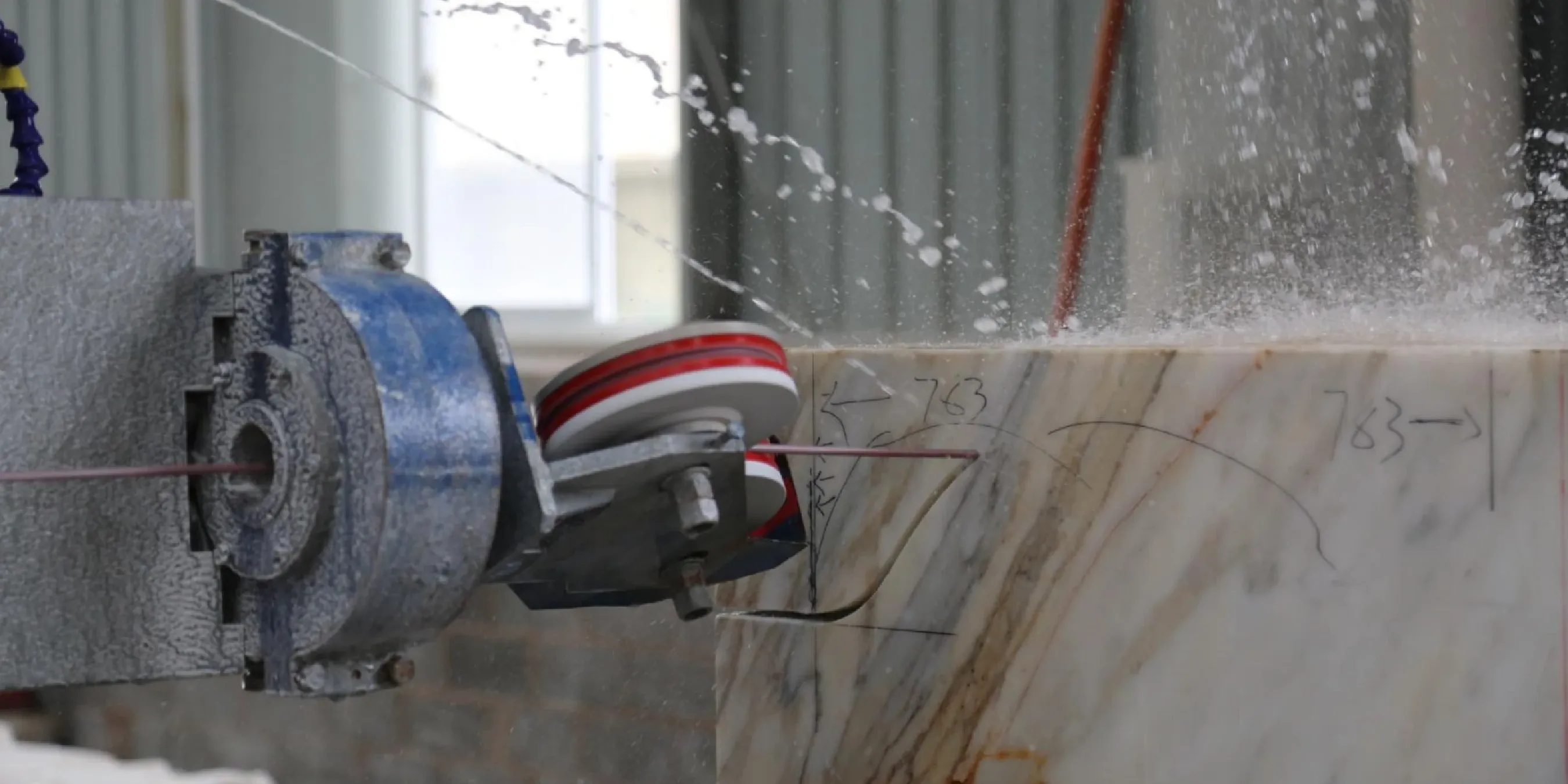
Instead of forcing the stone through a rigid blade, the diamond wire gradually removes material along the programmed contour, which helps maintain consistency over long distances.
Attention is focused on wire tracking stability and coolant coverage along the full cutting path.
Because the cut extends across a large surface, operators monitor the process to ensure the wire remains smoothly engaged without sudden changes in resistance.
Quality is judged by the continuity of the curve and surface condition after cutting.
If the profile follows the intended shape cleanly and the surface remains suitable for downstream grinding and polishing, the cut is considered successful.
The marble block was securely positioned and supported to prevent movement during cutting.
The cutting path was programmed to follow the counter’s curved profile in a single continuous operation.
The CNC wire saw machine carried out the cut with stable feed and consistent cooling, allowing the wire to pass smoothly through the block from start to finish.
After cutting, the shaped sections were prepared for subsequent profiling and surface finishing.
The cut surfaces showed smooth, continuous curves without visible interruptions.
The marble retained structural stability throughout the process.
The resulting shape was suitable for further finishing operations, including edge refinement and polishing.
Overall handling remained predictable for large, heavy stone blocks.
This case is relevant if you are handling:
Large marble blocks for reception or bar counters
Custom interior stone with long curved profiles
One-piece or segmented counter fabrication
Projects where visual continuity is critical
If your workshop frequently produces large, curved stone elements, this case reflects a practical cutting approach used in real production environments.
 English
Get A Easy Solution
Chat Online
Hi, this is Lizzy from Dinosaw ( Not a Robot ). Which Machine ( model ) do you want? Please WhatsApp us now
Hello 👋 How can we help?